- Free Consultation 24/7: (813) 222-2220 Tap Here To Call Us


Illegal Search and Seizure Florida Drug Cases



Questions & Answers with W.F. “Casey” Ebsary Jr.
Introduction
Illegal Search and Seizure? I am W.F. “Casey” Ebsary Jr., a Board-Certified Criminal Trial Lawyer and former prosecutor. I handle drug cases throughout Florida where constitutional violations may impact the outcome. Many drug arrests involve searches that may not comply with legal standards. I represent individuals throughout Florida whose cases involve serious constitutional issues, including illegal search and seizure. In many drug prosecutions, the most important issue is not what was found—but how it was found.
If law enforcement violated your rights, the evidence against you may be suppressed, which can dramatically change the outcome of your case. This page explains how search and seizure law works in Florida drug cases and what you need to know right now. If you are searching for information about illegal search and seizure in Florida drug cases, this issue can be critical to your defense.
FAQ Understanding Search and Seizure Laws in Florida Drug Cases

The Fourth Amendment to the United States Constitution and Article I, Section 12 of the Florida Constitution protect individuals against unreasonable searches and seizures. In the context of drug defense, these legal standards are the primary shield for the accused. If law enforcement exceeds their authority, the evidence they find—no matter how incriminating—may be excluded from court.
An illegal search occurs when law enforcement violates constitutional protections while obtaining evidence. These protections generally require officers to follow specific legal standards, such as obtaining a warrant based on probable cause, before searching a person, vehicle, or residence. Under Florida Statute 933.02, a search warrant may only be issued upon a showing of probable cause supported by an affidavit.
In many drug cases, including cocaine and trafficking prosecutions, the legality of the search becomes the central issue in determining whether the case can proceed. For example, issues involving possession charges, such as those discussed at Possession of Cocaine, often turn on whether the initial police contact and subsequent search were lawfully executed. If officers fail to follow proper procedures, the evidence may be suppressed under the “Exclusionary Rule,” established by the U.S. Supreme Court in Mapp v. Ohio, 367 U.S. 643 (1961).
The method used to obtain evidence often determines whether it can be used in court at all. Even if illegal substances are found, the case may be significantly weakened or dismissed if the search violated legal standards. This principle is often referred to as the “fruit of the poisonous tree” doctrine, as articulated in Wong Sun v. United States, 371 U.S. 471 (1963).
This is especially true in serious felony cases, including trafficking offenses explained at Florida Cocaine Minimum Mandatory Law. In these high-stakes scenarios, the admissibility of the evidence is just as important as the quantity of the substance involved. Strategic defense often focuses on the “how” and “why” of the police investigation to protect the client’s rights.
While the warrant requirement is the standard, police do not always need one if a specific exception applies. Common exceptions include “plain view,” “consent,” and “search incident to a lawful arrest.” According to the U.S. Department of Justice, these exceptions are narrowly defined and frequently litigated in court.
In many cases analyzed at drug2go.com, disputes arise over whether law enforcement properly relied on an exception, particularly during vehicle stops or roadside investigations. If an officer claims they smelled marijuana or saw drug paraphernalia to justify a warrantless search, the defense must scrutinize the officer’s credibility and the physical facts of the scene. If no valid exception existed, the search is unconstitutional.
If a search is determined to be illegal, the evidence obtained may be excluded through a “Motion to Suppress.” This is a formal request to the judge to prevent the prosecution from using specific evidence at trial. In Florida, this procedure is governed by Florida Rule of Criminal Procedure 3.190(g).
In serious cases involving cocaine trafficking, the loss of key evidence can be outcome-determinative. Without the physical drugs or the statements made during an illegal detention, the prosecution’s ability to prove the case beyond a reasonable doubt often evaporates. This frequently results in a significant reduction of charges or a complete dismissal of the case.
| Search Exception | Requirements | Common Challenge |
| Consent | Must be voluntary and given by someone with authority. | Was the consent coerced or “implied” by a show of authority? |
| Plain View | Officer must be legally present; incriminating nature must be immediately apparent. | Was the officer’s initial entry or stop lawful? |
| Automobile Exception | Probable cause that the vehicle contains contraband. | Did the “probable cause” exist before the search began? |
| Exigent Circumstances | Immediate danger to life or risk of evidence destruction. | Was the “emergency” manufactured by the police? |
Suppression can completely change the direction of a case. If the primary evidence—the drugs themselves—is excluded, the State may no longer have a “prima facie” case to move forward. This is why early legal analysis and aggressive motion practice are the cornerstones of a professional defense.
Many cases involving possession or trafficking depend entirely on whether the evidence is admissible. For more details on these defenses, visit our About Page. Without the physical evidence, the prosecution’s case often collapses, providing the defense with significant leverage during plea negotiations or leading to a victory before the trial even starts.
Illegal search and seizure issues most frequently arise during traffic stops, vehicle searches, and residential investigations (knock-and-talks). In Florida, a stop that begins lawfully for a minor traffic infraction may become unlawful if it is extended longer than necessary to issue a citation without additional reasonable suspicion.
This “prolonged detention” issue was addressed by the U.S. Supreme Court in Rodriguez v. United States, 575 U.S. 348 (2015), which held that a police stop exceeding the time needed to handle the matter for which the stop was made violates the Constitution. These issues commonly arise in drug possession and trafficking cases where K-9 units are called to the scene.
Constructive possession refers to situations where drugs are not found on a person’s body but in a location they supposedly control, such as a glove box, a shared trunk, or a kitchen cabinet. To prove this, the State must show the defendant had knowledge of the presence of the substance and the ability to maintain dominion and control over it.
This issue is frequently addressed in cases like Possession of Cocaine. Search and seizure issues often intersect with constructive possession because if the initial search of the vehicle or home was illegal, the question of who “possessed” the items becomes moot. Challenging the search is often the most effective way to beat a constructive possession charge.
Suppression is not limited to physical drugs. It can also include cash, scales, baggies, and even incriminating statements made by the defendant. If a defendant makes a confession after being illegally detained, that statement may be suppressed as well.
In high-level trafficking prosecutions, where the State relies on a combination of physical evidence and electronic surveillance, the scope of suppression can be vast. The Florida Bar Journal frequently publishes updates on how digital evidence and vehicle telematics are handled under the Fourth Amendment. Each piece of evidence must be vetted for constitutional compliance.
When a potential violation is identified, we file a Motion to Suppress Evidence. An evidentiary hearing is then held where the officers must testify under oath. The judge reviews the facts, body camera footage, and police reports to determine whether the officers’ actions were lawful.
This process requires a meticulous review of the “discovery” (evidence) provided by the State. If the judge grants the motion, the evidence is “thrown out,” and the State’s case is typically crippled. This is why hiring an experienced attorney who understands the nuances of Florida search and seizure law is vital. To start this process, visit our Contact Page.
Timing is critical in drug cases. Evidence such as surveillance footage from nearby businesses or dashcam video can be deleted or overwritten if not preserved quickly. Furthermore, legal challenges must be raised through specific pre-trial motions; failure to do so can result in a “waiver” of your rights.
Early intervention by an attorney allows for the immediate identification of constitutional weaknesses. This is particularly important in serious cases with mandatory prison sentences. Waiting to consult a lawyer can limit your options and significantly affect the outcome of your case.
More Questions and Answers on Illegal Search and Seizure Florida Drug Cases
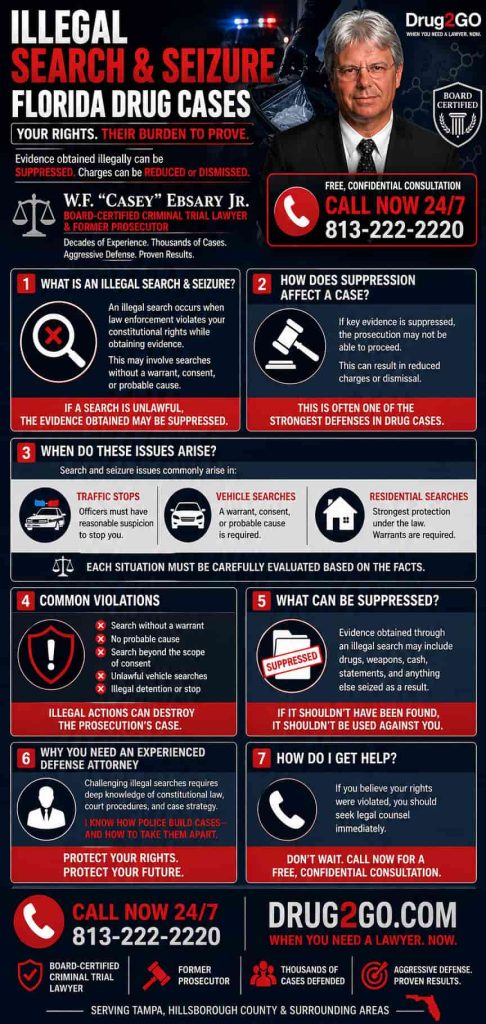
What is an illegal search and seizure?
An illegal search occurs when law enforcement violates your constitutional rights while obtaining evidence. This may involve searches without a warrant, consent, or probable cause.
If a search is unlawful, the evidence obtained may be suppressed.
How does suppression affect a case?
If key evidence is suppressed, the prosecution may not be able to proceed. This can result in reduced charges or dismissal.
This is often one of the strongest defenses in drug cases.
When do these issues arise?
Search and seizure issues commonly arise in traffic stops, vehicle searches, and residential searches.
Each situation must be carefully evaluated based on the facts.
How do I get help?
If you believe your rights were violated, you should seek legal counsel immediately.
Contact: https://drug2go.com/contact-casey-the-lawyer/



We Accept the Following Credit Cards:


