- Free Consultation 24/7: (813) 222-2220 Tap Here To Call Us


Tampa Drug Crimes Defense: The “Knowledge” Requirement


Knowledge Requirement in Drug Cases
Tampa Drug Crimes Defense – If you are facing charges for drug conspiracy or possession with intent to distribute, the most critical element of the government’s case is often the one hardest to prove: Knowledge. In the federal system, and specifically within the jurisdiction of the 11th Circuit (which covers Florida), simply being near drugs or even transporting them is not enough to prove a crime.
The Landmark Case: United States v. Terry Pierre Louis – Tampa Drug Crimes Defense
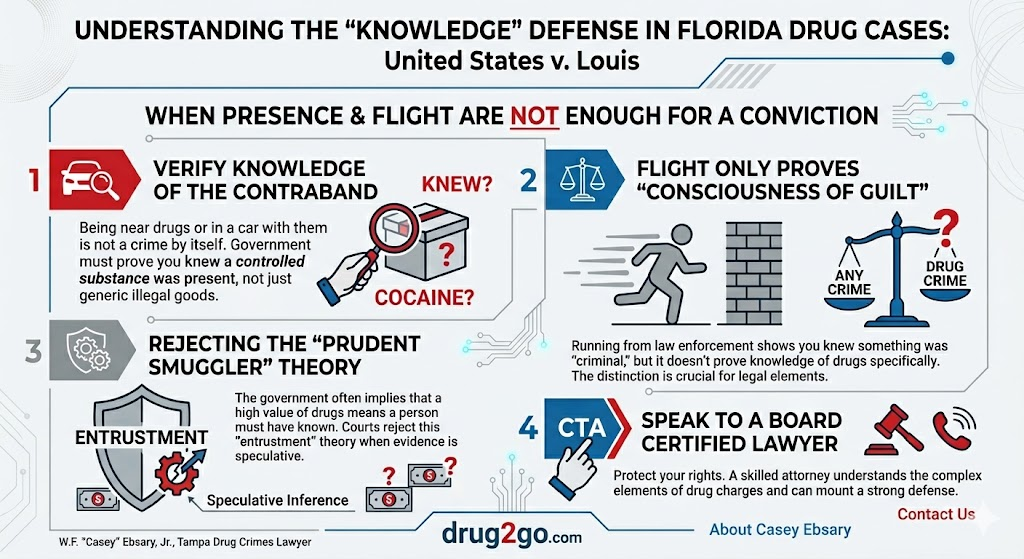
The case of United States v. Louis, 861 F.3d 1330 (11th Cir. 2017), remains one of the most significant victories for the defense regarding the “Knowledge” element in drug trafficking cases. It serves as a shield in Tampa Drug Crimes Defense for individuals who are present during a crime but have no specific knowledge that controlled substances are involved.

Frequently Asked Tampa Drug Crimes Defense Questions: Drug Conspiracy and the Element of Knowledge
The Eleventh Circuit Court of Appeals reversed the conviction of Terry Pierre Louis because the government failed to prove he knew the boxes in his car contained a controlled substance. While the government showed Louis was present and even fled from the police, the court held that these facts only proved he knew he was involved in something “criminal,” not specifically a drug crime. Under 21 U.S.C. § 841, the government must prove the defendant knew the specific nature of the contraband was a controlled substance to sustain a conviction.
The government often argues that a “prudent smuggler” would never entrust a high value of narcotics—in this case, 111 bricks of cocaine—to someone who didn’t know they were there. Prosecutors use this to imply that if you are in possession of a large quantity of drugs, you must have been “entrusted” with that knowledge because the cargo is too valuable to risk on an innocent person. However, in Louis, the court rejected this theory because the defendant was only in the car briefly and was never left alone with the boxes, meaning the “entrustment” was insufficient to prove knowledge.
While flight is often admitted in court as “evidence of consciousness of guilt,” it does not automatically prove the specific elements of a drug charge. In the Louis case, the defendant exited the car and ran when unmarked law enforcement vehicles approached with lights and sirens. The 11th Circuit acknowledged that while this flight suggested Louis knew he was doing something illegal, it was not enough to prove beyond a reasonable doubt that he knew the illegal activity involved controlled substances specifically.
“Mere presence” at the scene of a crime or simple association with people committing a crime is not enough to support a conspiracy conviction under federal law. To prove a conspiracy, the government must show there was an agreement to violate drug laws and that the defendant knew of the agreement and voluntarily joined it. If you were simply asked to drive a car or move boxes without being told what was inside them, your “presence” does not equate to a legal “conspiracy” to distribute drugs in a Tampa Drug Crimes Defense.
The law requires the government to prove a defendant knew they were dealing with a “controlled substance” rather than just generic “contraband” like untaxed cigarettes or stolen electronics. In the Louis case, the court emphasized that precedent requires proof that the defendant knew the boxes contained a drug regulated by the government. Without evidence that the defendant was told what was in the boxes or saw the contents, the government cannot meet its burden of proof for a violation of the Controlled Substances Act.
Understanding the Burden of Proof in a Tampa Drug Crimes Defense: Knowledge Requirement
The following table illustrates the gap between what the government suspects and what the government must prove in a Tampa drug trafficking case based on the Louis decision.
| Government Evidence | Legal Interpretation in Louis | Verdict Impact |
| Defendant drove the car | Mere presence/transportation | Insufficient |
| 111 Bricks of Cocaine found | High value cargo (Entrustment) | Insufficient |
| Defendant fled the scene | General consciousness of guilt | Insufficient |
| Lack of specific drug talk | No proof of knowledge of contents | Conviction Reversed |
Federal vs. Florida State Drug Laws
Whether your case is in the Middle District of Florida (Federal) or a Hillsborough County courtroom (State), the “Knowledge” element is a cornerstone of your defense.
- Federal Statutes: Most federal drug trafficking cases fall under 21 U.S.C. § 846 (Conspiracy) and 21 U.S.C. § 841 (Distribution).
- Florida Statutes: State charges often involve Florida Statute 893.135, which carries heavy mandatory minimum sentences for trafficking.
For more information on the specific penalties associated with these charges, you can visit the Official Website of the Florida Legislature.
The Role of a Board Certified Criminal Trial Lawyer
When the government relies on theories like “entrustment” or “guilt by association,” you need an attorney who understands how to apply appellate decisions like United States v. Louis to your specific facts. I have spent my career dismantling the government’s assumptions and holding them to the highest standard of proof.
If you have been charged based on “mere presence” or find yourself accused of a conspiracy you didn’t know existed, you need a defense built on local experience and national precedent.
- Learn more about my experience: W.F. “Casey” Ebsary, Jr. Bio Page
- Schedule a confidential consultation: Contact Our Tampa Office
Why the “Louis” Drug Case Matters to You
The Louis decision is a reminder that the system is designed to protect the innocent from being swept up in broad law enforcement stings. In that case, Customs and Border Protection had watched a vessel for four days, found nothing, and eventually arrested a man who was simply doing his job moving boxes for his employer.
Because the government could not provide a single witness to say they told Louis there were drugs in those boxes, and because there was no “wiretap” evidence showing he discussed cocaine, his conviction could not stand. We use these same strategies to protect our clients today.
Professional Legal Assistance in Tampa
If you are under investigation by the DEA, FBI, or local Hillsborough County Sheriff’s Office, do not wait for the government to build their case. Reach out to a lawyer who knows how to fight drug conspiracy charges.
Law Office of W.F. “Casey” Ebsary, Jr.
2102 W Cleveland St
Tampa, Florida 33606
Call: (813) 222-2220
Full Text of the Opinion: United States v. Terry Pierre Louis
UNITED STATES OF AMERICA, Plaintiff-Appellee, v. TERRY PIERRE LOUIS, Defendant-Appellant.
No. 16-11349 | July 10, 2017
United States Court of Appeals, Eleventh Circuit.
Appeal from the United States District Court for the Southern District of Florida. Before TJOFLAT and WILSON, Circuit Judges, and ROBRENO, District Judge.
WILSON, Circuit Judge:
Terry Pierre Louis appeals his convictions for conspiracy to possess with intent to distribute cocaine, in violation of 21 U.S.C. § 846, and possession with intent to distribute cocaine, in violation of 21 U.S.C. § 841(a)(1). Louis argues that the evidence was insufficient to support his convictions because the government failed to prove he knew the boxes placed in his car contained a controlled substance. After thorough review, and with the benefit of oral argument, we agree. Because a reasonable jury could not find that Louis had the requisite knowledge based on the evidence presented at trial, we reverse his convictions.
I. BACKGROUND
In April 2015, Customs and Border Protection (CBP) received a tip that the M/V Sea Hauler, a coastal freighter that exports goods from Miami to Haiti, was returning to Miami carrying narcotics. When the ship arrived, CBP agents boarded and searched it for four days but found no narcotics. During this time, the crew remained on the ship. Louis, an employee of the ship’s owner, helped provide food to the confined crew.
Following the unsuccessful search, agents set up surveillance. An agent saw a deck watchman carry two large cardboard boxes from inside the ship. Later, a forklift moved the boxes off the freighter. The ship’s owner then directed a car—driven by Louis—to park near the boxes. The owner opened the passenger rear door, and two men loaded the boxes inside. Louis began driving slowly toward the front of the shipyard while the owner walked alongside.
As the car exited the shipyard, unmarked law enforcement vehicles moved in with sirens and lights. Louis stopped the car, jumped out, and fled. He was quickly apprehended. Inside the car, the boxes were found to contain 111 bricks of cocaine.
II. DISCUSSION
To support a conviction for conspiracy to distribute or possession with intent to distribute, the government must prove the defendant knew the substance involved was a controlled substance. United States v. Ohayon, 483 F.3d 1281, 1293 (11th Cir. 2007).
The government argues that Louis’s flight and his presence during the loading of the boxes prove his knowledge. We disagree. While flight and presence are evidence of “consciousness of guilt,” they do not prove that a defendant knew he was involved in a drug crime as opposed to some other illegal activity, such as transporting stolen goods or un-manifested cargo.
We also reject the government’s “entrustment” theory. The government argued that because the cocaine was worth millions of dollars, a “prudent smuggler” would not entrust it to an innocent driver. However, the evidence showed Louis was in the car with the boxes for only a very short time and was never left alone with them. Under these facts, the inference of knowledge from the value of the drugs is too speculative to support a conviction beyond a reasonable doubt.
Because the government offered no evidence that Louis saw the contents of the boxes, heard any conversations about drugs, or was told what he was transporting, the evidence is insufficient.
REVERSED.
Visit our About Page for more information on our firm’s history of defending high-stakes drug cases.


We Accept the Following Credit Cards:


