- Free Consultation 24/7: (813) 222-2220 Tap Here To Call Us


Tiger Woods DUI Arrest in Jupiter Island: What This Case Reveals About Florida DUI Drug Law



A Real-World Drug DUI Scenario in Florida
When news broke that Tiger Woods was involved in a rollover crash and arrested on suspicion of DUI in Jupiter Island, it immediately raised serious legal questions. As a Florida DUI defense attorney, I pay close attention to cases like this because they highlight how DUI investigations actually unfold in real time—especially when impairment is suspected from substances other than alcohol.
According to the Martin County Sheriff’s Office, the crash occurred shortly after 2 p.m. when Woods attempted to pass a truck, clipped a trailer, and rolled his vehicle. He was not injured but reportedly showed signs of impairment. A breath test came back negative, and he refused a urine test—leading to charges of DUI with property damage and refusal to submit to testing.
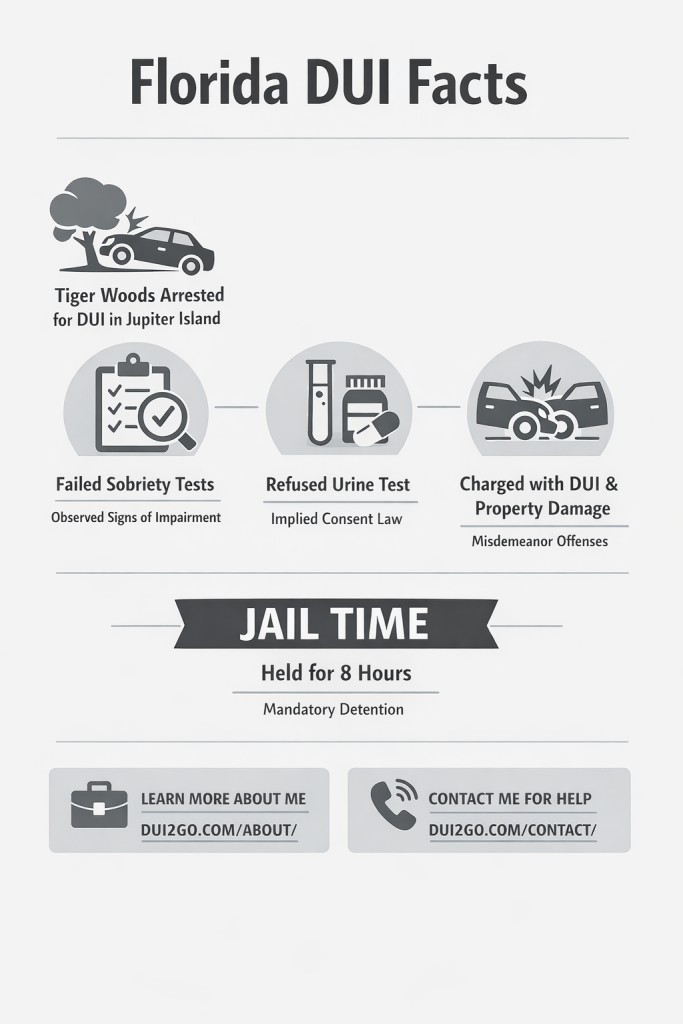
Below, I break this situation down into questions I routinely receive from clients facing DUI charges in Florida.
What Happens When a Driver Tests Negative on a Breathalyzer but Still Gets Arrested for DUI?
A negative breath test does not end a DUI investigation in Florida. I regularly explain to clients that alcohol is only one possible impairing substance. Law enforcement officers are trained to look for impairment caused by drugs, prescription medication, or a combination of substances.
In a case like this, officers may rely on observed behavior—such as driving patterns, physical appearance, and field sobriety exercises—to establish probable cause. If they believe impairment exists, they can still make an arrest even without alcohol evidence. The legal battle then shifts to whether the State can prove impairment beyond a reasonable doubt.
For more on DUI standards, I recommend reviewing the Florida statute directly at Florida Statutes DUI Law (316.193) and a reliable summary via Justia Florida DUI Statute 316.193.
What Does It Mean to Refuse a Urine Test in Florida?
Under Florida’s implied consent law, a driver who lawfully operates a vehicle is deemed to have consented to chemical testing if lawfully arrested for DUI. A refusal to submit to a urine test can have both administrative and criminal consequences.
From my experience defending these cases, a refusal can be used by prosecutors as evidence of consciousness of guilt. Additionally, a refusal may trigger a driver’s license suspension through the Florida Department of Highway Safety and Motor Vehicles. However, the legality of the request and the officer’s compliance with proper procedure are always critical issues that I examine in every case.
You can review the implied consent framework at Florida Statutes Implied Consent Law (316.1932) and its breakdown at Justia Florida Statute 316.1932.
Can Prescription Medication Lead to a DUI Arrest?
Yes—and this is one of the most misunderstood aspects of Florida DUI law. I frequently represent individuals who were legally prescribed medication but were still arrested for DUI.
Florida law does not distinguish between illegal drugs and lawful prescriptions when it comes to impairment. The key issue is whether the substance impaired the driver’s normal faculties. In high-profile cases like this, reports suggested possible impairment by medication, which is entirely consistent with how these cases are prosecuted.
However, proving impairment from medication is often more complex than alcohol-related cases. It may require toxicology reports, expert testimony, and careful cross-examination of the officer’s observations.
What Are the Criminal Charges for DUI with Property Damage in Florida?
DUI with property damage is generally charged as a misdemeanor in Florida. Based on my experience, this type of charge often arises when a crash occurs—even if no one is injured.
The prosecution must prove that the driver was under the influence and caused damage to another person’s property or vehicle. This adds an additional layer to the case, as it involves both impairment and causation.
For a statutory reference, see Florida Statutes DUI Damage (316.193(3)) and the corresponding explanation at Justia Florida DUI Damage Statute.
Is Jail Time Mandatory After a DUI Arrest in Florida?
Florida law does impose certain mandatory conditions following a DUI arrest. One commonly discussed rule is the requirement that a person must remain in custody for a minimum period—often cited as eight hours—before release if they are still considered impaired.
However, the exact application of this rule can depend on multiple factors, including the individual’s condition and the circumstances of the arrest. In practice, I always advise clients that release timing varies and should not be assumed.
For official guidance, refer to Florida DUI Detention Rules.
How Do Officers Determine “Impairment” Without Alcohol Evidence?
In non-alcohol DUI cases, impairment is often established through a combination of officer observations and standardized field sobriety tests. These may include balance tests, eye movement evaluations, and divided attention tasks.
From a defense perspective, I closely analyze whether these tests were administered correctly and whether external factors—such as fatigue, injury, or road conditions—could have affected performance. Without a chemical test confirming drug presence, the State’s case often relies heavily on subjective observations.
This is where experienced legal defense becomes critical.
What Role Does a Crash Play in a DUI Case?
A crash significantly increases the likelihood of arrest and prosecution. When law enforcement arrives at a crash scene, they are already investigating a potential violation of traffic laws.
If they observe signs of impairment, the crash itself can be used as circumstantial evidence. In my practice, I often challenge whether the crash was actually caused by impairment or by other factors such as road conditions, vehicle issues, or the actions of another driver.
What Happens Next After a DUI Arrest in Florida?
After an arrest, the case typically proceeds through several stages, including arraignment, pretrial motions, and potentially trial. At the same time, there is a separate administrative process involving the driver’s license.
I always emphasize to clients that early intervention is critical. Evidence such as dashcam footage, witness statements, and toxicology results must be preserved and analyzed quickly.
If you or a loved one is facing a DUI charge, I encourage you to learn more about my background on my bio page:
👉 https://dui2go.com/about/
Or contact me directly to discuss your case:
👉 https://dui2go.com/contact/
DUI Case Timeline in Florida
| Stage | What Happens | Why It Matters |
|---|---|---|
| Arrest | Officer determines probable cause | Sets foundation for charges |
| Booking | Processing and possible detention | Triggers administrative license issues |
| Arraignment | Formal charges presented | Opportunity to enter plea |
| Discovery | Evidence exchange | Critical for building defense |
| Trial or Resolution | Case resolved | Determines outcome |
Common DUI Evidence in Florida Cases
| Type of Evidence | Description | Defense Considerations |
|---|---|---|
| Officer Observations | Behavior, speech, appearance | Subjective and challengeable |
| Field Sobriety Tests | Physical coordination tests | Must follow strict protocols |
| Chemical Tests | Breath, blood, urine | Accuracy and legality issues |
| Crash Evidence | Vehicle damage and reports | Causation disputes |
Video: Understanding DUI Stops and Arrests
Frequently Asked Questions About DUI in Florida
Can you be charged with DUI without alcohol in your system?
Yes. I routinely defend cases where no alcohol is present. Florida law focuses on impairment, not just blood alcohol content, and substances like medications can form the basis of a DUI charge.
Is refusing a urine test always a bad idea?
Not necessarily. While refusal has consequences, there are situations where it may limit the evidence available to the State. Each case is fact-specific, and I evaluate this issue carefully with my clients.
Are DUI charges always misdemeanors?
No. While many first-time DUI cases are misdemeanors, certain factors—such as injuries or repeat offenses—can elevate the charge to a felony. The specific facts of the case are critical.
How important is the crash in proving DUI?
A crash can be important, but it does not automatically prove impairment. I often challenge whether the crash was actually caused by DUI or by other independent factors.
What should I do immediately after a DUI arrest?
I advise contacting an experienced DUI defense attorney as soon as possible. Early action can make a significant difference in preserving evidence and protecting your rights.
Final Thoughts
High-profile cases like this one involving Tiger Woods remind us that DUI investigations are complex and fact-specific. A negative breath test does not end the inquiry, and allegations of impairment from medication can present unique legal challenges.
As someone who has spent years defending DUI cases across Florida, I know that every detail matters—from the initial traffic stop to the final resolution. If you are facing a similar situation, I am here to help guide you through the process with experience and precision.
👉 Learn more about me: https://dui2go.com/about/
👉 Contact me today: https://dui2go.com/contact/
Source: https://spectrumlocalnews.com/app for updates.


We Accept the Following Credit Cards:


