- Free Consultation 24/7: (813) 222-2220 Tap Here To Call Us


Automatic License Plate Readers – ALPR Camera


ALPR Camera Stops in Tampa FL: Valid Reasonable Suspicion?
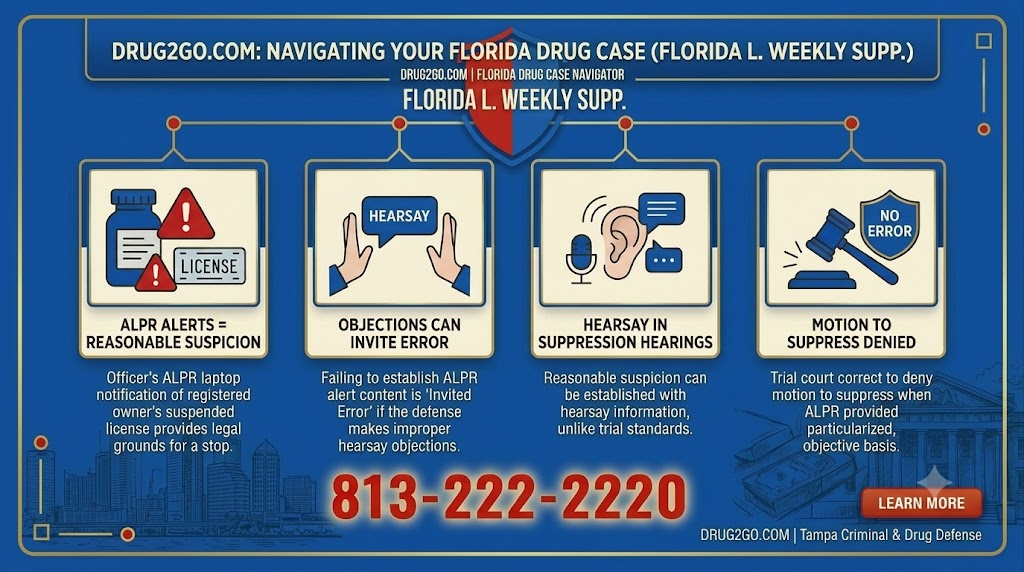
Automated License Plate Readers (ALPR) have transformed law enforcement traffic details across Florida. In Baptiste v. State (28 Fla. L. Weekly Supp. 7a), the Eleventh Judicial Circuit Court (Appellate) addressed a critical Fourth Amendment question: Does an automated notification on an officer’s laptop generated by a license plate reader provide the reasonable suspicion needed to perform a lawful traffic stop? The court ruled unequivocally that it does.
Stopped by an ALPR surveillance camera in Tampa or Central Florida? Our legal team investigates system misreads and stale database lag. Learn how Board Certified Trial Expert Casey Ebsary defends tech-based stops.
1. Case Summary: Baptiste v. State
The Background & Incident
On April 14, 2019, Officer Sofia Darias of the Miami Beach Police Department was conducting an ALPR detail at 7th Street and Washington Avenue. A stationary camera automatically captured passing tags and cross-referenced them against state databases.
When Kerwien Baptiste drove past, the ALPR scanned his tag and issued an automated alert to Officer Darias’s cruiser laptop stating: “Hey, we need to address this person.”
Officer Darias initiated a traffic stop. When asked for his driver’s license, Baptiste admitted his license was suspended—a status Officer Darias then confirmed via a database search. Baptiste was cited for Driving While License Suspended with Knowledge (DWLS).
The Trial & Defense Challenge
At his bench trial in Miami-Dade County Court, Baptiste filed a Motion to Suppress, claiming the traffic stop was illegal. He argued that the prosecution failed to prove the exact underlying reason for the ALPR hit at trial (i.e., whether the alert explicitly showed the owner’s driver’s license was suspended). The trial judge denied the motion to suppress, found Baptiste guilty, and Baptiste appealed.
2. Appellate Analysis & Legal Holdings
The Eleventh Circuit Appellate Bench (Trawick, Walsh, and Rebull, JJ., opinion by Rebull, J.) affirmed the trial court’s ruling based on three distinct legal grounds:
A. An ALPR “Hit” Inherently Establishes Founded Suspicion
Under Florida law (State v. Laina, 175 So. 3d 897), an investigatory stop requires a “founded suspicion“—an objective, particularized basis grounded in specific facts:
- Particularized: The system alert targets a specific license plate number.
- Objective: The hit relies on computer database matching rather than an officer’s subjective hunch or arbitrary judgment.
The court held that an ALPR alert instructing an officer to “address” a vehicle gives the officer sufficient reasonable suspicion to execute a stop, even without reading the specific underlying record detail first.
B. Evidentiary Proof of License Suspension
During trial, when asked how she knew Baptiste’s license was suspended, Officer Darias testified: “I received notification that it was suspended.” The appellate court concluded that this testimony—viewed in the light most favorable to sustaining the trial court ruling—demonstrated that the laptop alert explicitly communicated the suspension, placing the case squarely under Laina.
C. The Invited Error Doctrine
When prosecutors tried to question Officer Darias about the exact wording of the laptop alert, defense counsel objected on hearsay grounds.
The appellate court highlighted two major flaws in the defense’s approach:
- Hearsay is Admissible in Suppression Matters: Reasonable suspicion and probable cause can be established using hearsay (Johnson v. State, 660 So. 2d 648; Alabama v. White, 496 U.S. 325). The defense’s objection was legally erroneous.
- Invited Error: Under the invited error doctrine (Mora v. State, 964 So. 2d 881), a defendant cannot block evidence from entering the record through improper objections and then claim on appeal that the prosecution failed to prove that same evidence.
3. Fourth Amendment Framework: Surveillance & Public Roads
Florida ALPR Fourth Amendment Analysis Flow
| Procedural Step | Action / Outcome | Legal Status / Authority |
| I. Activity | Driver engages in Public Roadway Travel. | Visible to public and law enforcement. |
| II. Surveillance | ▼ ALPR Optical Capture of license plate. | ► No 4th Amendment Search (No expectation of privacy on public tags). |
| III. Technology | ▼ Automated Database Match (Cross-referencing hotlists). | Background system process. |
| IV. Communication | ▼ In-Car Computer Alert received by officer. | ► Establishes “Founded Suspicion” (Baptiste v. State, 28 Fla. L. Weekly Supp. 7a). |
| V. Outcome | ▼ Lawful Traffic Stop initiated. | Valid investigatory stop based on tech-assisted reasonable suspicion. |
Summary of Key Findings from Baptiste v. State
- Objective Suspicion: The court held that an ALPR “hit” providing a notification that a person needs to be “addressed” constitutes a particularized and objective basis—a “founded suspicion”—for an investigatory stop.
- Invited Error: If the defense prevents the specific text of the ALPR alert from coming into evidence through incorrect hearsay objections at the trial level, they cannot argue on appeal that the alert content was unproven.
- Database Accuracy: Once a valid automated alert provides reasonable suspicion, an officer is not required to confirm the database information through an independent source before initiating the traffic stop.
Baptiste fits into a broader constitutional framework regarding police technology and automated surveillance:
- No Privacy Expectation in Public Tags: Under Katz v. United States, items exposed to the public receive no Fourth Amendment protection. License plates are visible to any observer, meaning automated optical recognition (OCR) scanning does not constitute a “search.”
- Point-in-Time Scans vs. Mosaic Surveillance: Courts treat point-in-time street scans differently from long-term aggregate tracking. While multi-week continuous tracking across vast camera networks raises potential “Mosaic Theory” privacy issues (Carpenter v. United States), a discrete hit at a single intersection is a constitutionally sound investigative tool.
4. Defense Strategies: Challenging ALPR Stops in Florida
Because Florida appellate courts accept automated system alerts as a valid basis for a stop, criminal defense attorneys must target the technical integrity and officer procedures surrounding the hit:
| Defense Vector | Practical Method & Focus |
| OCR Character Misreads | Subpoena raw ALPR image logs to verify if the camera misread similar characters (e.g., confusing B with 8 or O with 0), creating a false hit. |
| Database Lag / Stale Entries | Audit the time gap between when a client reinstated their license or cleared a record and when the local ALPR database was last updated. |
| Failure of Secondary Verification | Cross-examine the arresting officer on whether they conducted a live database check (e.g., DAVID or FCIC/NCIC) or visually confirmed the tag prior to initiating the stop. |
| Driver Identity Discrepancies | Determine if the officer verified whether the driver matched the physical description of the registered owner who triggered the suspension alert. |
Key Takeaway
Baptiste v. State confirms that an automated license plate reader hit provides valid reasonable suspicion for a traffic stop in Florida. For motorists facing charges originating from an ALPR alert, legal defense strategies must move beyond challenging the initial camera scan itself and focus on technical system errors, stale database records, and law enforcement’s duty of verification.
If an automated Tampa police camera triggered your traffic stop for drug charges the fight isn’t over. Challenge the database accuracy now. Contact Tampa DUI Expert Casey Ebsary for a free case analysis.
Full Text of ALPR Automatic License Plate Reader Opinion
Here is the text from the document:
28 Fla. L. Weekly Supp. 7a
Online Reference: FLWSUPP 2801ВАРТ
Criminal law — Driving while license suspended with knowledge — Search and seizure — Vehicle stop — License plate reader — Officer who received notification from automatic license plate reader that person needed to be “addressed” and that registered owner of tag had suspended license had reasonable suspicion for vehicle stop — Any error in failing to establish content of notification from license plate reader was invited by defense’s erroneous hearsay objections to questions about that content — No error in denying motion to suppress
KERWIEN BAPTISTE, Appellant, v. STATE OF FLORIDA, Appellee. Circuit Court, 11th Judicial Circuit (Appellate) in and for Miami-Dade County. Case No. 2019-000273-AC-01. L.T. Case No. AB8H0KE. March 16, 2020. An Appeal from the County Court in and for Miami-Dade County, Robin Faber, Judge. Counsel: Carlos J. Martinez, Office of the Public Defender and James Odell, Assistant Public Defender, for Appellant. Katherine Fernandez Rundle, Office of the State Attorney and Kathryn Della Ferra, Assistant State Attorney, for Appellee.
(Before TRAWICK, WALSH and REBULL, JJ.)
(REBULL, J.) The issue presented in this case is whether a notification on a police officer’s laptop from a license plate reader provides reasonable suspicion for the officer to conduct an investigatory stop of the motor vehicle triggering the notification. We hold that it does, and therefore affirm the judgement appealed and the trial court’s denial of Mr. Baptiste’s motion to suppress.
I.
On April 14, 2019, Miami Beach police officer Sofia Darias was conducting a license plate reader¹ detail at the intersection of 7th street and Washington Avenue in the City of Miami Beach. A camera fixed at that location randomly captures images of license plates and runs the license plate numbers through a database. On that date, the camera captured an image of the license plate on the motor vehicle Mr. Baptiste was driving.
After the running the license plate number through a database, the software on Officer Darias’s laptop in her police cruiser then issued an alert or notification. Officer Darias testified that “electronically, a review of that license plate’s number is made and, if it gets a hit, it tells you, “Hey, we need to address this person.” The trial court, clarified, “So, you have a laptop. You’re there and, all of a sudden, it alerts you to a particular car; is that it or a plate that is on car?” The witness replied, “Yes, Your Honor.”
As a result, Officer Darias conducted a traffic stop of that motor vehicle. Mr. Baptiste, who was driving, was unable to produce his driver’s license at Officer Darias’s request. He told her that his driver’s license was suspended. After confirming Mr. Baptiste’s suspension in her database, Officer Darias issued him a traffic citation for driving while knowing his driver’s license was suspended.
At the bench trial for this charge, Mr. Baptiste moved to suppress the evidence obtained as a result of the traffic stop, arguing that the stop was illegal. The trial judge denied the motion, and ultimately found Mr. Baptiste guilty of driving while knowing his driver’s license was suspended. Mr. Baptiste appeals that judgment, and raises as his sole issue on appeal the trial court’s denial of his motion to suppress.
II.
Mr. Baptiste’s argues that the evidence elicited in the trial court did not establish the content of the notification that Officer Darias received from the software. In other words, the evidence does not reflect why the license plate reader registered a hit for the license plate of the vehicle that Mr. Baptiste was driving. Did the notification, for example, reflect that the registered owner of the motor vehicle with that license plate had a suspended driver’s license? Absent that information, Mr. Baptiste argues that the evidence fails to demonstrate that Officer Darias had reasonable suspicion to stop Mr. Baptiste.
We reject this argument for several reasons. Preliminarily, we note that in “reviewing an order on a motion to suppress, the reviewing court is to consider the evidence presented at the suppression hearing in a light most favorable to sustaining the trial court’s ruling.” See Sims v. State, 805 So. 2d 44, 45 (Fla. 1st DCA 2001) [27 Fla. L. Weekly D26a]. Seen in that light, the evidence presented in this case was that the camera captured an image of the license plate on the car Mr. Baptiste was driving. The software in the system electronically reviewed the tag number in its database. That review led to a “hit,” which then notified Officer Darias on her laptop, “Hey, we need to address this person.” That alone provided Officer Darias with reasonable suspicion to conduct a traffic stop of Mr. Baptiste’s vehicle.
In State v. Laina, 175 So. 3d 897 (Fla. 5th DCA 2015) [40 Fla. L. Weekly D2117d), a police officer ran his own check on the license plate of a vehicle he was following. The results of his search revealed that the registered owner of the vehicle had a suspended license. The Laina Court held that this information gave the officer reasonable suspicion to conduct a traffic stop of the vehicle.
Police may make an investigatory stop if police have reasonable suspicion that a suspect has committed, is committing, or is about to commit a crime, based on the totality of the circumstances…. Reasonable suspicion is more than a mere hunch, but specific and articulable facts, together with the rational inferences from those facts, that reasonably warrant the investigatory stop.
[R]eviewing courts… must look at the ‘totality of the circumstances’ of each case to see whether the detaining officer has a ‘particularized and objective basis’ for suspecting legal wrongdoing.
To justify temporary detention, only “founded suspicion” in the mind of the detaining officer is required. A “founded suspicion” is a suspicion which has some factual foundation in the circumstances observed by the officer, when those circumstances are interpreted in the light of the officer’s knowledge.
State v. Laina, 175 So. 3d 897, 898 (Fla. 5th DCA 2015) [40 Fla. L. Weekly D2117d]. Here, Officer Darias plainly had a “founded suspicion” to stop Mr. Baptiste. This was not a mere hunch. The basis for the stop was “particularized,” in that it was a hit directed to the specific license plate number on the vehicle he was driving. And it was “objective,” in that it did not depend on Officer Darias’s subjective interpretation of what she was seeing, but instead on the computer software database generating a “hit” that the vehicle needed to be addressed. When interpreted in the light of Officer Darias’s knowledge, she had a founded suspicion to pull over Mr. Baptiste. The trial judge properly denied the motion to suppress.2
III.
Additional testimony elicited from Officer Darias at the hearing, seen in the light most favorable to sustaining the trial judge’s ruling, supports the basis for the stop. At trial, the prosecutor marked as an exhibit the traffic printout, or driving history, of Mr. Baptiste from the Florida Department of Highway Safety and Motor Vehicles. The prosecutor then asked Officer Darias some questions and the following colloquy took place:
☐ So, Officer, looking at this traffic history, on the date of the incident which was April 14, 2019, was Mr. Baptiste’s license suspended?
A Yes.
Q And, how do you know that?
A I received notification that it was suspended.
MR. GARDINER: Objection. Hearsay.
THE COURT: You are so soft-spoken. I can hardly hear you.
BY MS. DELLA FERA:
☐ Using — using the information
THE COURT: Just a second. I didn’t hear the prior response.
MS. DELLA FERA: I’m sorry, Judge.
THE COURT: Can you repeat it, Officer. I’m sorry.
THE WITNESS: I received notification that it was suspended, Your Honor.
THE COURT: What — now, the question was what the document says.
BY MS. DELLA FERA:
☐ So, using the information in front of you, how did you know that the license was suspended?
And, you can flip through the whole document.
(Trial Tr. 33-34) (emphasis added).
This testimony reflects that the notification Officer Darias received on her laptop was that the registered owner linked to the tag number captured by the license plate reader had a suspended driver’s license. The exchange in the transcript makes clear that Officer Darias misunderstood the question about the driving history printout, and instead testified to the contents of the notification she received on her laptop. This of course provides an independent reasonable suspicion for the stop of Mr. Baptiste. It places this case squarely within the holding of the Laina, which also involved a record check which revealed that the registered owner’s license was suspended. See also Ellis v. State, 935 So. 2d 29 (Fla. 2d DCA 2006) [31 Fla. L. Weekly D1734a] (response from computer database query that tag had “no record found” gave police officer reasonable suspicion to stop vehicle for tag not assigned). The trial judge correctly denied the motion to suppress.
IV.
Lastly, to the extent that there was any error in failing to establish the content of the notification that Officer Darias received on her laptop, the defense invited that error.
“The [invited error] doctrine prevents a party from inviting error, then attempting to make that error an issue on appeal. See Norton v. State, 709 So.2d 87, 94 (Fla.1997) [23 Fla. L. Weekly S12a] (the invited error doctrine prevents a party from making or inviting error in a case and then taking advantage of that error on appeal)….” Mora v. State, 964 So. 2d 881, 883 (Fla. 3d DCA 2007) [32 Fla. L. Weekly D2320a].
Under the invited-error doctrine, a party may not make or invite error at trial and then take advantage of the error on appeal. In the instant case, if any error was committed in honoring the defendant’s demand for speedy trial, the defendant clearly invited the error. Therefore, the defendant cannot take advantage on appeal of the situation he created at trial.
Anderson v. State, 93 So. 3d 1201, 1206 (Fla. 1st DCA 2012) [37 Fla. L. Weekly D1891c].
Here, when the State attempted to elicit testimony from Officer Darias regarding the content of the notification she received on the vehicle Mr. Baptiste was driving, the defense objected on hearsay grounds.
☐ How did you first come in contact with Mr. Baptiste?
A I was conducting a license reader detail on 7th and Washington Avenue. I received a notification that —
MR. GARDINER: Objection. Hearsay.
This objection was erroneous. Probable cause may be based entirely on hearsay. “Unlike the burdens of proof in a criminal trial, the obligation to establish probable cause in an affidavit may be met by hearsay, by fleeting observations, or by tips received from unnamed reliable informants . .” Johnson v. State, 660 So. 2d 648, 654 (Fla. 1995) [20 Fla. L. Weekly S347a]. If probably cause may be based on hearsay, then certainly reasonable suspicion can too.
“Reasonable suspicion is a less demanding standard than probable cause not only in the sense that reasonable suspicion can be established with information that is different in quantity or content than that required to establish probable cause, but also in the sense that reasonable suspicion can arise from information that is less reliable than that required to show probable cause.” Alabama v. White, 496 U.S. 325, 330 (1990). As a result, Officer Darias should have been permitted to testify freely without objection regarding the content of the notification she received on her laptop from the license plate reader and the hit in the database. Counsel cannot object to that information coming into evidence, and then argue on appeal that it was error to fail to determine the content of the notification to which he objected.
Conclusion
For these reasons, we affirm the lower court’s denial of the motion to suppress, and the judgment and sentence on appeal.
AFFIRMED. (TRAWICK AND WALSH, JJ., concur.)
1″Ordinarily, automatic license plate reader (“ALPR”) technology utilizes highspeed computer- controlled cameras mounted on fixed structures or on patrol cars. The camera automatically captures an image of the license plate of each vehicle that passes through its optical range. For each image, the ALPR system uses character recognition software and almost instantly checks the license plate number against a given database, containing a list of license plates belonging to sex offenders, crime suspects, fugitives, or amber alert subjects and/or missing persons, as well as stolen or unregistered vehicles.” Kimberly J. Winbush, Annotation, Use of License Plate Readers, 32 A.L.R.7th Art. 8 (Originally published in 2017).
2The Supreme Courts of Ohio and Kentucky have each recently issued opinions holding that information obtained from license plate reader systems provided reasonable suspicion to justify a traffic stop of vehicles generating a hit. See State v. Hawkins, 2019-Ohio-4210, 158 Ohio St. 3d 94, reconsideration denied, 2019-Ohio-5327, 157 Ohio St. 3d 1524, 137 N.E.3d 109; Traft v. Commonwealth, 539 S.W.3d 647 (Ky. 2018).
3″This court, too, has held that the defendant’s driving record as maintained by the DMV is sufficient to prove that his license was revoked due to his habitual traffic offender designation. State v. Fields, 809 So.2d 99 (Fla. 2d DCA 2002) [27 Fla. L. Weekly D476b]. See also Rodgers v. State, 804 So.2d 480 (Fla. 4th DCA 2001) [26 Fla. L. Weekly D2886a] (holding that certified copy of computer printout of defendant’s driving record maintained by DMV was sufficient to present prima facie case of driving while license revoked as habitual traffic offender, and that State was not required to prove each qualifying conviction for DWLS.)” State v. Miller, 830 So. 2d 214, 215 (Fla. 2d DCA 2002) [27 Fla. L. Weekly D2418b].


We Accept the Following Credit Cards:


