

Serious Charges
Serious Defense
Fight To Win


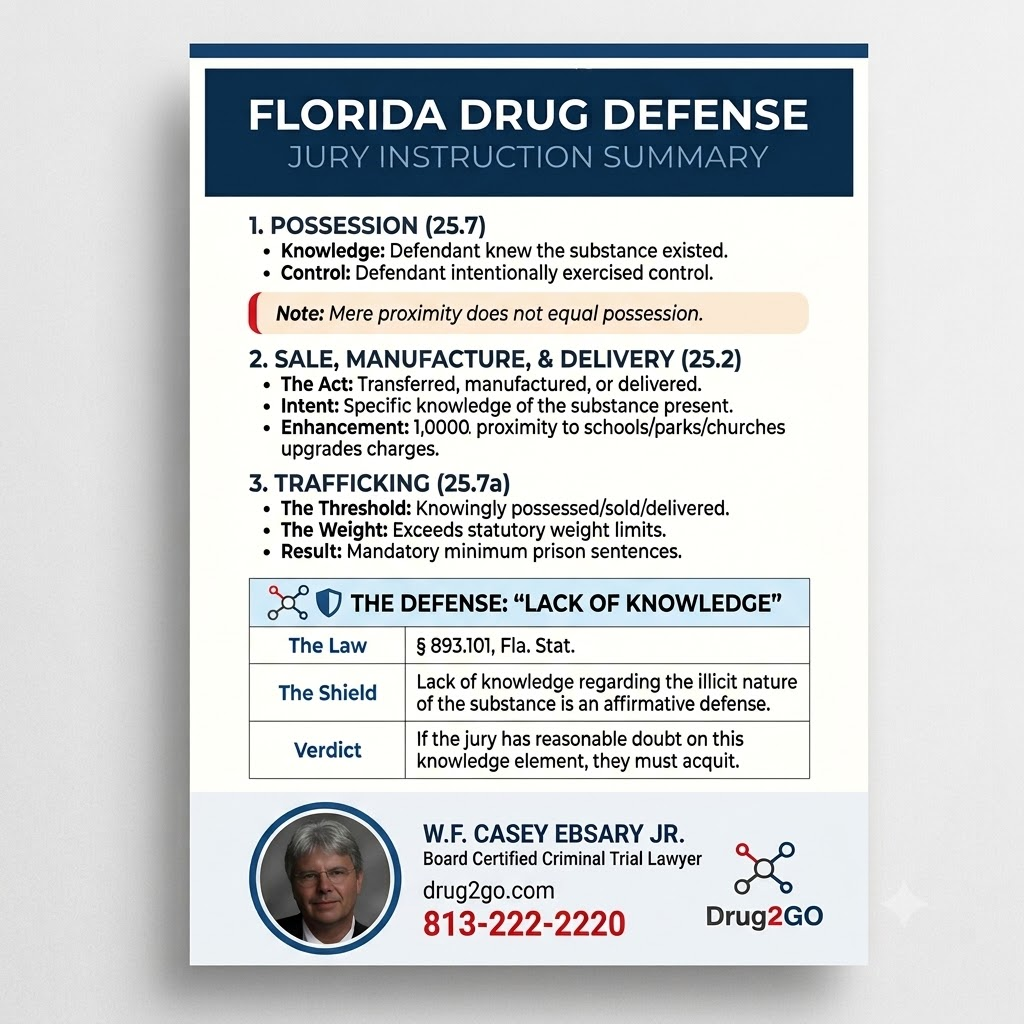
Florida Drug Crimes Jury Instructions
Florida Drug Crimes Jury Instructions: A Trial Lawyer’s Guide
If you are facing drug charges in Florida, understanding the exact rules the jury will use to decide your fate is critical. I am W.F. Casey Ebsary Jr., a Florida Bar Board Certified Criminal Trial Lawyer practicing in the Tampa Bay area. Since my days at the University of Florida in the 1970s and graduating cum laude from Stetson University College of Law, I have dedicated my career to holding the prosecution to the highest possible legal standard.
When we take a drug case to trial, we rely heavily on Florida’s Standard Jury Instructions. These instructions are the binding legal roadmaps read to the jury by the judge before deliberations begin. They dictate exactly what the State must prove beyond a reasonable doubt—whether your charge involves possession, trafficking, manufacturing, or the delivery of a controlled substance. If the prosecution fails to prove even a single required element, such as your actual knowledge of the illicit nature of the substance, the jury must return a verdict of not guilty.
Below is a comprehensive listing of Florida Drug Crimes Jury Instructions. We use these instructions daily to build formidable defenses, scrutinizing definitions like “actual, constructive, or attempted transfer” and “possession” to dismantle the State’s case.

You do not have to face the daunting criminal justice system alone. To learn more about me and how my extensive trial experience can benefit your case, please visit my bio page at https://drug2go.com/about/. If you need immediate assistance with your drug charge, reach out to me directly via my contact page at https://drug2go.com/contact/. We are here to fight for you.
As a Florida Bar Board Certified Criminal Trial Lawyer, I know that understanding the exact penalties you are facing is just as critical as knowing the jury instructions themselves. At drug2go.com, we break down these complex statutes so you know precisely what is at stake. Below is a detailed table mapping the Florida Drug Crimes Jury Instructions to their corresponding statutory penalties.
Table: Florida Drug Crimes Jury Instructions and Statutes
| Instruction | Crime | Florida Statute | Statutory Penalty (Degree) |
| 25.1 | Sale of a Substance in Place of a Controlled Substance | § 817.563 | 3rd Degree Felony or 2nd Degree Misdemeanor (depends on substance schedule) |
| 25.2 | Sale, Purchase, Manufacture, Delivery, or Possession with Intent | § 893.13(1)(a), (2)(a) | Varies: 2nd Degree Felony, 3rd Degree Felony, or 1st Degree Misdemeanor |
| 25.3 | Sale, Purchase, Delivery, or Possession in Excess of 10 Grams | § 893.13(1)(b), (2)(b), (6)(c) | 1st Degree Felony |
| 25.4 | Delivery of a Controlled Substance to or Use of Minor | § 893.13(4) | Varies: 1st, 2nd, or 3rd Degree Felony |
| 25.5 | Bringing a Controlled Substance Into the State | § 893.13(5) | Varies: 2nd Degree Felony, 3rd Degree Felony, or 1st Degree Misdemeanor |
| 25.6 | Sell, Manufacture, Deliver, or Possession with Intent in Specified Locations | § 893.13(1)(c)–(f), (h) | Varies: Enhances to 1st Degree Felony or 2nd Degree Felony |
| 25.7 | Possession of a Controlled Substance | § 893.13(6) | 3rd Degree Felony (1st Degree Misdemeanor for Cannabis ≤ 20g) |
| 25.7(a) | Trafficking | § 893.135(1) | 1st Degree Felony (with mandatory minimum prison terms and fines) |
| 25.8 | Obtaining a Controlled Substance by Fraud, Etc. | § 893.13(7)(a)9. | 3rd Degree Felony |
| 25.9 | Sale, Manufacture, Delivery, or Possession with Intent… [Fentanyl] | § 893.13(1)(i) | I do not know the exact penalty with 100% certainty, but this acts as a penalty enhancement |
| 25.13(f) | [Ownership] [Lease] [Rental] of a Place for Trafficking/Sale/Manufacture | § 893.1351(1) | 3rd Degree Felony |
| 25.13(g) | Possession of a Place for Trafficking/Sale/Manufacture | § 893.1351(2) | 2nd Degree Felony |
| 25.13(h) | Possession of a Place Used to Manufacture… (Minor Present) | § 893.1351(3) | 1st Degree Felony |
| 25.14 | Use or Possession with Intent to Use Drug Paraphernalia | § 893.147(1) | 1st Degree Misdemeanor |
| 25.15 | Delivery, Possession with Intent to Deliver, or Manufacture with Intent to Deliver Drug Paraphernalia | § 893.147(2) | 3rd Degree Felony |
| 25.15(a) | Retail Sale of Drug Paraphernalia | § 893.147(6) | 1st Degree Misdemeanor (1st offense); 3rd Degree Felony (subsequent) |
| 25.16 | Delivery of Drug Paraphernalia to a Minor | § 893.147(3)(a) | 2nd Degree Felony |
| 25.17 | Contraband in County Detention Facility | § 951.22 | 3rd Degree Felony or 1st Degree Misdemeanor (varies by item) |
| 25.18 | Contraband in a Juvenile [Detention Facility] [Commitment Program] | § 985.711 | 3rd Degree Felony (varies by item) |
| 25.19 | Counterfeit-Resistant Prescription Blanks | § 831.311 | 3rd Degree Felony |
| 25.20 | Possession of Contraband in a State Correctional Institution | § 944.47(1)(c) | 2nd Degree Felony or 3rd Degree Felony (varies by item) |
| 25.21 | [Introduction] [Removal] of Contraband [Into] [From] a State Correctional Institution | § 944.47(1)(a) | 2nd Degree Felony or 3rd Degree Felony (varies by item) |
| 25.22 | Unlawful Distribution Causing an Overdose or Serious Bodily Injury | § 893.131 | 2nd Degree Felony (1st Degree Felony if prior conviction) |
| 25.23 | Reckless Exposure Causing an Overdose or Serious Bodily Injury | § 893.132 | 2nd Degree Felony |
If you or someone you know is facing these harsh penalties, do not wait. We have the experience needed to challenge the evidence. Learn more about my background at https://drug2go.com/about/ or reach out to us directly to build your defense at https://drug2go.com/contact/ or call 813-222-2220.

Complete Florida Standard Jury Instructions in Drug Criminal Cases
TABLE OF CONTENTS
- 25.1 Sale of a Substance in Place of a Controlled Substance
- 25.2 Sale, Purchase, Manufacture, Delivery, or Possession with Intent to Sell, Purchase, Manufacture, or Deliver a Controlled Substance
- 25.3 Sale, Purchase, Delivery, or Possession in Excess of Ten Grams of a Controlled Substance
- 25.4 Delivery of a Controlled Substance to or Use of Minor
- 25.5 Bringing a Controlled Substance Into the State
- 25.6 Sell, Manufacture, Deliver, or Possession with Intent to Sell, Manufacture or Deliver a Controlled Substance in Specified Locations
- 25.7 Possession of a Controlled Substance
- 25.7(a) Trafficking in (Name of Controlled Substance)
- 25.8 Obtaining a Controlled Substance by Fraud, Etc.
- 25.9 Sale, Manufacture, Delivery, or Possession with Intent to Sell, Manufacture, or Deliver [Fentanyl] [Insert Relevant Substance]
- 25.13(f) [Ownership] [Lease] [Rental] of a Place for [[Trafficking in] [Sale of] a Controlled Substance] [Manufacturing a Controlled Substance Intended for Sale or Distribution]
- 25.13(g) Possession of a Place for [[Trafficking in] [Sale of] a Controlled Substance] [Manufacturing a Controlled Substance Intended for Sale or Distribution]
- 25.13(h) Possession of a Place Used to Manufacture a Controlled Substance Intended for Sale or Distribution (Minor Present or in Residence)
- 25.14 Use or Possession with Intent to Use Drug Paraphernalia
- 25.15 Delivery, Possession with Intent to Deliver, or Manufacture with Intent to Deliver Drug Paraphernalia
- 25.15(a) Retail Sale of Drug Paraphernalia
- 25.16 Delivery of Drug Paraphernalia to a Minor
- 25.17 Contraband in County Detention Facility
- 25.18 Contraband in a Juvenile [Detention Facility] [Commitment Program]
- 25.19 Unlawful Sale, Manufacture, Alteration, Delivery, Uttering or Possession of Counterfeit-Resistant Prescription Blanks for Controlled Substances
- 25.20 Possession of Contraband [In] [Upon the Grounds of] a State Correctional Institution
- 25.21 [Introduction] [Removal] of Contraband [Into] [From] a State Correctional Institution
- 25.22 Unlawful Distribution of (Name(s) of Enumerated Controlled Substance(s)) Causing an Overdose or [Serious Bodily Injury]
- 25.23 Reckless Exposure Causing an Overdose or Serious Bodily Injury
25.1 SALE OF A SUBSTANCE IN PLACE OF A CONTROLLED SUBSTANCE
§ 817.563, Fla. Stat.
To prove the crime of Sale of a Substance in Place of a Controlled Substance, the State must prove the following two elements beyond a reasonable doubt:
- (Defendant) without legal authority agreed, consented, or offered to sell (substance prohibited by § 893.03, Fla. Stat.).
- (Defendant) did sell a different substance in place of (substance prohibited by § 893.03, Fla. Stat.).
Definition
“Sell” means the actual transfer or delivery of something to another person in exchange for money or something of value.
Lesser Included Offenses
SALE OF SUBSTANCE IN PLACE OF A CONTROLLED SUBSTANCE — 817.563
| CATEGORY ONE | CATEGORY TWO | FLA. STAT. | INS. NO. |
| None | |||
| Attempt | 777.04(1) | 5.1 |
Comment
This instruction was adopted in 1995.
25.2 SALE, PURCHASE, MANUFACTURE, DELIVERY, OR POSSESSION WITH INTENT TO SELL, PURCHASE, MANUFACTURE, OR DELIVER A CONTROLLED SUBSTANCE
§ 893.13(1)(a), Fla. Stat.; § 893.13(2)(a), Fla. Stat.
Certain drugs and chemical substances are by law known as “controlled substances.” (Specific substance alleged) is a controlled substance.
To prove the crime of (crime charged), the State must prove the following three elements beyond a reasonable doubt:
1. (Defendant) [sold] [manufactured] [delivered] [purchased] [possessed with intent to [sell] [manufacture] [deliver] [purchase]] a certain substance.
2. The substance was (specific substance alleged).
3. (Defendant) had knowledge of the presence of the substance.
Delivery of 20 Grams or Less of Cannabis without consideration is a misdemeanor. See § 893.13(3), Fla. Stat. If the State charges the felony of Delivery of More Than 20 Grams of Cannabis, the jury must make a finding as to the weight. Give if applicable.
If you find that (defendant) is guilty of Delivery of Cannabis, you must then determine if the State proved beyond a reasonable doubt that the cannabis weighed more than 20 grams.
Definitions. Give as applicable.
Cannabis. § 893.02(3), Fla. Stat.
See Comment section for medical marijuana.
Cannabis means all parts of any plant of the genus Cannabis, whether growing or not and the seeds thereof; and the resin extracted from any part of the plant; and every compound, manufacture, salt, derivative, mixture, or preparation of the plant or its seeds or resin.
Sell.
“Sell” means to transfer or deliver something to another person in exchange for money or something of value or a promise of money or something of value.
Manufacture. § 893.02(15)(a), Fla. Stat.
“Manufacture” means the production, preparation, propagation, compounding, cultivating, growing, conversion, or processing of a controlled substance, either directly or indirectly, by extraction from substances of natural origin, or independently by means of chemical synthesis, or by a combination of extraction and chemical synthesis, and includes any packaging of the substance or labeling or relabeling of its container.
Give if applicable.
The term “manufacture” does not include the preparation, compounding, packaging, or labeling of a controlled substance by:
- A practitioner or pharmacist as an incident to his or her administering or delivering of a controlled substance in the course of his or her professional practice.
- A practitioner, or by his or her authorized agent under the practitioner’s supervision, for the purpose of, or as an incident to, research, teaching, or chemical analysis, and not for sale.
Deliver. § 893.02(6), Fla. Stat.
“Deliver” or “delivery” means the actual, constructive, or attempted transfer from one person to another of a controlled substance, whether or not there is an agency relationship.
Possession.
To prove (defendant) “possessed a substance,” the State must prove beyond a reasonable doubt that [he] [she] a) knew of the existence of the substance and b) intentionally exercised control over that substance.
Give if applicable.
Control can be exercised over a substance whether the substance is carried on a person, near a person, or in a completely separate location. Mere proximity to a substance does not establish that the person intentionally exercised control over the substance in the absence of additional evidence. Control can be established by proof that (defendant) had direct personal power to control the substance or the present ability to direct its control by another.
Joint possession. Give if applicable.
Possession of a substance may be sole or joint, that is, two or more persons may possess a substance.
Affirmative defense: Lack of knowledge of illicit nature. Give if applicable. § 893.101(2) and (3), Fla. Stat.
Lack of knowledge of the illicit nature of a controlled substance is a defense to (crime charged).
You may but are not required to infer that (defendant) was aware of the illicit nature of the controlled substance if you find that [he] [she] possessed the controlled substance.
Give if applicable. See McMillon v. State, 813 So. 2d 56 (Fla. 2002).
You may but are not required to infer that a person who sells a controlled substance knows of its illicit nature.
If you are convinced beyond a reasonable doubt that (defendant) knew of the illicit nature of the controlled substance, and all of the elements of the charge have been proved, you should find [him] [her] guilty of (crime charged).
If you have a reasonable doubt on the question of whether (defendant) knew of the illicit nature of the controlled substance, you should find [him] [her] not guilty of (crime charged).
Lesser Included Offenses
SALE, PURCHASE, MANUFACTURE, DELIVERY OR POSSESSION WITH INTENT— 893.13(1)(a) and (2)(a)
| CATEGORY ONE | CATEGORY TWO | FLA. STAT. | INS. NO. |
| *Possession of a Controlled Substance, if Possession With Intent is charged | 893.13(6) | 25.7 | |
| *Delivery of 20 Grams or Less of Cannabis, if Delivery of More than 20 Grams of Cannabis is charged | 893.13(3) | 25.2 | |
| Attempt, except when delivery is charged | 777.04(1) | 5.1 |
Comments
*The crime of Possession of a Controlled Substance is not a necessarily lesser-included crime of Manufacture of a Controlled Substance. Anderson v. State, 447 So. 2d 236 (Fla. 1st DCA 1983). Also, Possession of a Controlled Substance is not a necessary lesser–included offense of Sale of a Controlled Substance. State v. McCloud, 577 So. 2d 939 (Fla. 1991). It is unclear if the courts will determine that a person charged with Purchase or Delivery of a Controlled Substance is necessarily charged with Possession of a Controlled Substance.
If the State alleges the defendant possessed cannabis, in an amount more than 20 grams, with intent to sell, purchase, deliver, or manufacture the cannabis, there will be both a felony necessary lesser-included offense of simple possession and a misdemeanor lesser-included offense of simple possession. § 893.13(6)(b), Fla. Stat.
There is no crime of Attempted Delivery because the definition of “delivery” in § 893.03(6), Fla. Stat. includes the attempt to transfer from one person to another.
Starting in 2014, the Legislature passed laws pertaining to “medical cannabis” or “low-THC cannabis,” which is excluded from the definition of “cannabis” in § 893.02(3), Fla. Stat.; is defined in § 381.986(1), Fla. Stat.; and must be manufactured, possessed, sold, purchased, delivered, distributed, or dispensed in conformance with § 381.986, Fla. Stat. A special instruction will be necessary in cases where a defendant relies on a cannabis-related prescription defense.
This instruction was adopted in 1981 and amended in 1989 [543 So. 2d 1205], 1997 [697 So. 2d 84], 2007 [969 So. 2d 245], 2014 [153 So. 3d 192], 2016 [191 So. 3d 291], 2017 [216 So. 3d 497], and 2019.
25.3 SALE, PURCHASE, DELIVERY, OR POSSESSION IN EXCESS OF TEN GRAMS OF A CONTROLLED SUBSTANCE
§ 893.13(1)(b), Fla. Stat.; § 893.13(2)(b), Fla. Stat.; and § 893.13(6)(c), Fla. Stat.
Certain drugs and chemical substances are by law known as “controlled substances.” (Specific substance alleged) is a controlled substance.
To prove the crime of (crime charged), the State must prove the following four elements beyond a reasonable doubt:
1. (Defendant) [sold] [purchased] [delivered] [or] [possessed] [a certain substance] [a mixture] [a combination of substances].
2. The [substance] [mixture] [combination of substances] contained (specific substance alleged).
3. The [substance] [mixture] [combination of substances] weighed more than 10 grams.
4. (Defendant) had knowledge of the presence of the substance.
Definitions. Give as applicable.
Sell.
“Sell” means to transfer or deliver something to another person in exchange for money or something of value or a promise of money or something of value.
Deliver. § 893.02(6), Fla. Stat.
“Deliver” or “delivery” means the actual, constructive, or attempted transfer from one person to another of a controlled substance, whether or not there is an agency relationship.
Mixture. § 893.02(16), Fla. Stat.
“Mixture” means any physical combination of two or more substances, including, but not limited to, a blend, an aggregation, a suspension, an emulsion, a solution, or a dosage unit, whether or not such combination can be separated into its components by physical means, whether mechanical or thermal.
Possession.
To prove (defendant) “possessed a substance,” the State must prove beyond a reasonable doubt that [he] [she] a) knew of the existence of the substance and b) intentionally exercised control over that substance.
Give if applicable.
Control can be exercised over a substance whether the substance is carried on a person, near a person, or in a completely separate location. Mere proximity to a substance does not establish that the person intentionally exercised control over the substance in the absence of additional evidence. Control can be established by proof that (defendant) had direct personal power to control the substance or the present ability to direct its control by another.
Joint possession. Give if applicable.
Possession of a substance may be sole or joint, that is, two or more persons may possess a substance.
Affirmative defense: Lack of knowledge of illicit nature. Give if applicable. § 893.101(2) and (3), Fla. Stat.
Lack of knowledge of the illicit nature of a controlled substance is a defense to (crime charged). You may but are not required to infer that (defendant) was aware of the illicit nature of the controlled substance if you find that [he] [she] possessed the controlled substance.
Give if applicable. See McMillon v. State, 813 So. 2d 56 (Fla. 2002).
You may but are not required to infer that a person who sells a controlled substance knows of its illicit nature.
If you are convinced beyond a reasonable doubt that (defendant) knew of the illicit nature of the controlled substance, and all of the elements of the charge have been proved, you should find [him] [her] guilty of (crime charged).
If you have a reasonable doubt on the question of whether (defendant) knew of the illicit nature of the controlled substance, you should find [him] [her] not guilty of (crime charged).
Lesser Included Offenses
SALE, PURCHASE, DELIVERY, OR POSSESSION IN EXCESS OF 10 GRAMS — 893.13(1)(b), (2)(b), and (6)(c)
| CATEGORY ONE | CATEGORY TWO | FLA. STAT. | INS. NO. |
| Sale, purchase, or delivery of controlled substance if sale, purchase, or delivery is charged | 893.13(1)(a) and (2)(a) | 25.2 | |
| *Possession of a controlled substance, if possession is charged | 893.13(6) | 25.7 | |
| Attempt, except when delivery is charged | 777.04(1) | 5.1 |
Comments
*It is unclear if the courts will determine that Possession of a Controlled Substance is necessarily included in a charge of Purchase or Delivery of a Controlled Substance. Possession is not a necessary lesser–included offense of either Sale or Manufacture of a Controlled Substance. State v. McCloud, 577 So. 2d 939 (Fla. 1991); Anderson v. State, 447 So. 2d 236 (Fla. 1st DCA 1983).
There is no crime of Attempted Delivery because the definition of “delivery” in § 893.03(6), Fla. Stat., includes the attempt to transfer from one person to another.
This instruction was adopted in 1981 and amended in 1989 [543 So. 2d 1205], 1997 [697 So. 2d 84], 2007 [969 So. 2d 245], 2014 [153 So. 3d 192], 2016 [191 So. 3d 291], 2017 [216 So. 3d 497], and 2019.
25.4 DELIVERY OF A CONTROLLED SUBSTANCE TO OR USE OF MINOR
§ 893.13(4), Fla. Stat.
Certain drugs and chemical substances are by law known as “controlled substances.” (Specific substance alleged) is a controlled substance.
To prove the crime of (crime charged), the State must prove the following four elements beyond a reasonable doubt:
Give 1a, 1b, and/or 1c as applicable.
1. a. (Defendant) delivered a substance to a person under the age of 18 years.
b. (Defendant) used or hired a person under the age of 18 years as an agent or employee in the sale or delivery of a substance.
c. (Defendant) used a person under the age of 18 years to assist in avoiding detection or apprehension for (violation of chapter 893, Fla. Stat., alleged).
2. The substance was (specific substance alleged).
3. (Defendant) was 18 years of age or older at the time.
4. (Defendant) had knowledge of the presence of the substance.
Definition.
Deliver. § 893.02(6), Fla. Stat.
“Deliver” or “delivery” means the actual, constructive, or attempted transfer from one person to another of a controlled substance, whether or not there is an agency relationship.
Affirmative defense: Lack of knowledge of illicit nature. Give if applicable. § 893.101(2) and (3), Fla. Stat.
Lack of knowledge of the illicit nature of a controlled substance is a defense to (crime charged). You may but are not required to infer that (defendant) was aware of the illicit nature of the controlled substance if you find that [he] [she] possessed the controlled.
To prove (defendant) “possessed a substance,” the State must prove beyond a reasonable doubt that [he] [she] a) knew of the existence of the substance and b) intentionally exercised control over that substance.
Give if applicable.
Control can be exercised over a substance whether the substance is carried on a person, near a person, or in a completely separate location. Mere proximity to a substance does not establish that the person intentionally exercised control over the substance in the absence of additional evidence. Control can be established by proof that (defendant) had direct personal power to control the substance or the present ability to direct its control by another.
Joint possession. Give if applicable.
Possession of a substance may be sole or joint, that is, two or more persons may possess a substance.
If you are convinced beyond a reasonable doubt that (defendant) knew of the illicit nature of the controlled substance, and all of the elements of the charge have been proved, you should find [him] [her] guilty of (crime charged).
If you have a reasonable doubt on the question of whether (defendant) knew of the illicit nature of the controlled substance, you should find [him] [her] not guilty of (crime charged).
Lesser Included Offense
DELIVERY OF A CONTROLLED SUBSTANCE TO OR USE OF A MINOR — 893.13(4)
| CATEGORY ONE | CATEGORY TWO | FLA. STAT. | INS. NO. |
| *Delivery of a Controlled Substance | 893.13(1)(a) | 25.2 |
Comments
*It is unclear if the courts will determine that Possession of a Controlled Substance is a necessarily lesser–included offense of a charge involving Delivery of a Controlled Substance. Possession is not a necessary lesser-included offense of either Sale or Manufacture of a Controlled Substance. State v. McCloud, 577 So. 2d 939 (Fla. 1991); Anderson v. State, 447 So. 2d 236 (Fla. 1st DCA 1983).
There is no crime of Attempted Delivery because the definition of “delivery” in § 893.03(6), Fla. Stat., includes the attempt to transfer from one person to another.
This instruction was adopted in 1981 and amended in 1989 [543 So. 2d 1205], 2007 [969 So. 2d 245], 2014 [153 So. 3d 192], 2016 [191 So. 3d 291], 2017 [216 So. 3d 497], and 2019.
25.5 BRINGING A CONTROLLED SUBSTANCE INTO THE STATE
§ 893.13(5), Fla. Stat.
Certain drugs and chemical substances are by law known as “controlled substances.” (Specific substance alleged) is a controlled substance.
To prove the crime of Bringing a Controlled Substance Into the State, the State must prove the following three elements beyond a reasonable doubt:
1. (Defendant) brought a substance into Florida.
2. The substance was (specific substance alleged).
3. (Defendant) had knowledge of the presence of the substance.
Affirmative defense: Lack of knowledge of illicit nature. Give if applicable. § 893.101(2) and (3), Fla. Stat.
Lack of knowledge of the illicit nature of a controlled substance is a defense to Bringing a Controlled Substance Into the State. You may but are not required to infer that (defendant) was aware of the illicit nature of the controlled substance if you find that [he] [she] possessed the controlled substance.
To prove (defendant) “possessed a substance,” the State must prove beyond a reasonable doubt that [he] [she] a) knew of the existence of the substance and b) intentionally exercised control over that substance.
Give if applicable.
Control can be exercised over a substance whether the substance is carried on a person, near a person, or in a completely separate location. Mere proximity to a substance does not establish that the person intentionally exercised control over the substance in the absence of additional evidence. Control can be established by proof that (defendant) had direct personal power to control the substance or the present ability to direct its control by another.
Joint possession. Give if applicable.
Possession of a substance may be sole or joint, that is, two or more persons may possess a substance.
If you are convinced beyond a reasonable doubt that (defendant) knew of the illicit nature of the controlled substance, and all of the elements of the charge have been proved, you should find [him] [her] guilty of Bringing a Controlled Substance Into the State.
If you have a reasonable doubt on the question of whether (defendant) knew of the illicit nature of the controlled substance, you should find [him] [her] not guilty of Bringing a Controlled Substance Into the State.
Lesser Included Offenses
BRINGING A CONTROLLED SUBSTANCE INTO THE STATE — 893.13(5)
| CATEGORY ONE | CATEGORY TWO | FLA. STAT. | INS. NO. |
| *None | |||
| Attempt | 777.04(1) | 5.1 |
Comments
*It is unclear if the courts will determine that Possession of a Controlled Substance is necessarily included in a charge of Bringing a Controlled Substance into the State. Possession is not a necessary lesser–included offense of either Sale or Manufacture of a Controlled Substance. State v. McCloud, 577 So. 2d 939 (Fla. 1991); Anderson v. State, 447 So. 2d 236 (Fla. 1st DCA 1983).
Starting in 2014, the Legislature passed laws pertaining to “medical cannabis” or “low-THC cannabis,” which is excluded from the definition of “cannabis” in § 893.02(3), Fla. Stat.; is defined in § 381.986(1), Fla. Stat.; and must be manufactured, possessed, sold, purchased, delivered, distributed, or dispensed in conformance with § 381.986, Fla. Stat. A special instruction will be necessary in cases where a defendant relies on a cannabis-related prescription defense.
This instruction was adopted in 1981 and amended in 1997 [697 So. 2d 84], 2007 [969 So. 2d 245], 2014 [153 So. 3d 192], 2016 [191 So. 3d 291], 2017 [216 So. 3d 497], and 2019.
25.6 SELL, MANUFACTURE, DELIVER, OR POSSESSION WITH INTENT TO SELL, MANUFACTURE OR DELIVER A CONTROLLED SUBSTANCE IN SPECIFIED LOCATIONS
§ 893.13(1)(c)–(f) and (h), Fla. Stat.
Certain drugs and chemical substances are by law known as “controlled substances.” (Specific substance alleged) is a controlled substance.
To prove the crime of (crime charged), the State must prove the following four elements beyond a reasonable doubt:
1. (Defendant) [sold] [manufactured] [delivered] [possessed with intent to [sell] [manufacture] [deliver]] a certain substance.
Give as applicable. § 893.13(1)(c)–(f) and (h), Fla. Stat. To explain the specified locations, the judge should provide definitions (see below) from the appropriate statutes that are referred to in § 893.13(1), Fla. Stat.
2. The [sale] [manufacture] [delivery] [possession with intent to [sell] [manufacture] [deliver]] took place in, on, or within 1,000 feet of:
the real property comprising a child care facility;
the real property comprising a public or private [elementary] [middle] [secondary] school between the hours of 6:00 a.m. and 12:00 midnight;
the real property comprising [a state, county, or municipal park] [a community center] [a publicly-owned recreational facility];
the real property comprising a public or private college, university, or other postsecondary educational institution;
a physical place for worship at which a church or religious organization regularly conducts religious services;
a convenience business;
[the real property comprising a public housing facility];
the real property comprising a mental health facility;
the real property comprising a health care facility licensed under chapter 395, Florida Statutes, that provides substance abuse treatment;
the real property comprising a licensed service provider;
the real property comprising a facility providing services that include clinical treatment, intervention, or prevention;
the real property comprising a recovery residence;
the real property comprising an assisted living facility;
the real property comprising a pain management clinic.
3. The substance was (specific substance alleged).
4. (Defendant) had knowledge of the presence of the substance.
Sell.
“Sell” means to transfer or deliver something to another person in exchange for money or something of value or a promise of money or something of value.
Manufacture. § 893.02(15)(a), Fla. Stat.
“Manufacture” means the production, preparation, propagation, compounding, cultivating, growing, conversion, or processing of a controlled substance, either directly or indirectly, by extraction from substances of natural origin, or independently by means of chemical synthesis, or by a combination of extraction and chemical synthesis, and includes any packaging of the substance or labeling or relabeling of its container.
The term “manufacture” does not include the preparation, compounding, packaging, or labeling of a controlled substance by:
A practitioner or pharmacist as an incident to his or her administering or delivering of a controlled substance in the course of his or her professional practice.
A practitioner, or by his or her authorized agent under the practitioner’s supervision, for the purpose of, or as an incident to, research, teaching, or chemical analysis, and not for sale.
Deliver. § 893.02(6), Fla. Stat.
“Deliver” or “delivery” means the actual, constructive, or attempted transfer from one person to another of a controlled substance, whether or not there is an agency relationship.
Possession.
To prove (defendant) “possessed a substance,” the State must prove beyond a reasonable doubt that [he] [she] a) knew of the existence of the substance and b) intentionally exercised control over that substance.
Control can be exercised over a substance whether the substance is carried on a person, near a person, or in a completely separate location. Mere proximity to a substance does not establish that the person intentionally exercised control over the substance in the absence of additional evidence. Control can be established by proof that (defendant) had direct personal power to control the substance or the present ability to direct its control by another.
Joint possession. Give if applicable.
Possession of a substance may be sole or joint, that is, two or more persons may possess a substance.
Affirmative defense: Lack of knowledge of illicit nature. Give if applicable. § 893.101(2) and (3), Fla. Stat.
Lack of knowledge of the illicit nature of a controlled substance is a defense to (crime charged). You may but are not required to infer that (defendant) was aware of the illicit nature of the controlled substance if you find that [he] [she] possessed the controlled substance.
Give if applicable. See McMillon v. State, 813 So. 2d 56 (Fla. 2002).
You may but are not required to infer that a person who sells a controlled substance knows of its illicit nature.
If you are convinced beyond a reasonable doubt that (defendant) knew of the illicit nature of the controlled substance, and all of the elements of the charge have been proved, you should find [him] [her] guilty of (crime charged).
If you have a reasonable doubt on the question of whether (defendant) knew of the illicit nature of the controlled substance, you should find [him] [her] not guilty of (crime charged).
Define appropriate specified location(s) here. See § 893.13(1), Fla. Stat., for statutory cites for location definitions.
Lesser Included Offenses
SELL, MANUFACTURE, DELIVER, OR POSSESSION WITH INTENT TO SELL, MANUFACTURE OR DELIVER A CONTROLLED SUBSTANCE IN SPECIFIED LOCATIONS — 893.13(1)(c)–(f) and (h)
| CATEGORY ONE | CATEGORY TWO | FLA. STAT. | INS. NO. |
| *Sale, Manufacture, or Delivery of a controlled substance, if Sale, Manufacture, or Delivery is charged | 893.13(1)(a) | 25.2 | |
| *Possession of a Controlled Substance, if Possession with Intent to Sell, Manufacture, or Deliver is charged | 893.13(6) | 25.7 |
Comments
*The crime of Possession of a Controlled Substance is not a necessarily lesser-included crime of Manufacture of a Controlled Substance. Anderson v. State, 447 So. 2d 236 (Fla. 1st DCA 1983). Also, Possession of a Controlled Substance is not a necessary lesser–included offense of Sale of a Controlled Substance. State v. McCloud, 577 So. 2d 939 (Fla. 1991). It is unclear if the courts will determine that a person charged with Delivery of a Controlled Substance is necessarily charged with Possession of a Controlled Substance.
Starting in 2014, the Legislature passed laws pertaining to “medical cannabis” or “low-THC cannabis,” which is excluded from the definition of “cannabis” in § 893.02(3), Fla. Stat.; is defined in § 381.986(1), Fla. Stat.; and must be manufactured, possessed, sold, purchased, delivered, distributed, or dispensed in conformance with § 381.986, Fla. Stat. A special instruction will be necessary in cases where a defendant relies on a cannabis-related prescription defense.
Child care facility; affirmative defense. § 893.13(1)(c), Fla. Stat., requires the owner or operator of a child care facility to post a sign that is not less than 2 square feet in size with a word legend identifying the facility as a licensed child care facility and that the sign be posted on the property of the facility in a conspicuous place where it is reasonably visible to the public. According to Brevil v. State, 326 So. 3d 1129 (Fla. 4th DCA 2021), the absence of such a sign is an affirmative defense. Therefore, the defendant must meet his or her burden of production of non-compliance with the statutory signage requirements. As of November 2022, there is no case law that establishes which party has the burden of persuasion for the affirmative defense and what that burden is (preponderance, clear and convincing, or beyond a reasonable doubt). Until there is a statutory change or case law, trial judges will need to draft a special instruction that addresses these issues.
This instruction was adopted in 1981 and amended in 1989 [543 So. 2d 1205], 1997 [697 So. 2d 84], 2000 [765 So. 2d 692], 2007 [969 So. 2d 245], 2014 [153 So. 3d 192], 2016 [191 So. 3d 291], 2017 [216 So. 3d 497], 2019 [ 272 So. 3d 243], on December 15, 2021, and on December 21, 2022.
25.7 POSSESSION OF A CONTROLLED SUBSTANCE
§ 893.13(6), Fla. Stat.
Certain drugs and chemical substances are by law known as “controlled substances.” (Specific substance) is a controlled substance.
To prove the crime of Possession of a Controlled Substance, the State must prove the following [two] [three] elements beyond a reasonable doubt:
1. (Defendant) possessed a substance.
2. The substance was (specific substance).
§ 893.13(6)(b), Fla. Stat. Give if applicable.
The jury must make a finding as to weight if the defendant is charged with possessing more than 20 grams of cannabis.
3. The cannabis weighed more than 20 grams.
To prove (defendant) “possessed a substance,” the State must prove beyond a reasonable doubt that [he] [she] a) knew of the existence of the substance and b) intentionally exercised control over that substance.
Give if applicable.
Control can be exercised over a substance whether the substance is carried on a person, near a person, or in a completely separate location. Mere proximity to a substance does not establish that the person intentionally exercised control over the substance in the absence of additional evidence. Control can be established by proof that (defendant) had direct personal power to control the substance or the present ability to direct its control by another.
Joint possession. Give if applicable.
Possession of a substance may be sole or joint, that is, two or more persons may possess a substance.
Give if applicable. Cannabis. §§ 893.02(3), 893.13(6)(b), Fla. Stat.
See Comment section for medical marijuana.
Cannabis means all parts of any plant of the genus Cannabis, whether growing or not, and the seeds thereof [but does not include any resin extracted from the plant].
Affirmative defense: Lack of knowledge of illicit nature. Give if applicable. § 893.101(2) and (3), Fla. Stat.
Lack of knowledge of the illicit nature of a controlled substance is a defense to (crime charged). You may but are not required to infer that (defendant) was aware of the illicit nature of the controlled substance if you find that [he] [she] possessed the controlled substance.
If you are convinced beyond a reasonable doubt that (defendant) knew of the illicit nature of the controlled substance, and all of the elements of the charge have been proved, you should find [him] [her] guilty of Possession of a Controlled Substance.
If you have a reasonable doubt on the question of whether (defendant) knew of the illicit nature of the controlled substance, you should find [him] [her] not guilty of Possession of a Controlled Substance.
Lesser Included Offenses
POSSESSION OF A CONTROLLED SUBSTANCE — 893.13(6)
| CATEGORY ONE | CATEGORY TWO | FLA. STAT. | INS. NO. |
| Possession of Less than 20 Grams of Cannabis if the felony level of cannabis is charged | 893.13(6)(b) | 25.7 | |
| Attempt | 777.04(1) | 5.1 |
Comments
§ 893.21, Fla. Stat.
A person acting in good faith who seeks medical assistance for himself, herself, or another experiencing or believed to be experiencing a drug-related or alcohol-related overdose may not be prosecuted for simple Possession of a Controlled Substance if the evidence of the possession was obtained as a result of the person seeking medical assistance.
A special instruction is necessary when the defense is a mere involuntary or superficial possession. See cases such as Hamilton v. State, 732 So. 2d 493 (Fla. 2d DCA 1999) and Sanders v. State, 563 So. 2d 781 (Fla. 1st DCA 1990).
Starting in 2014, the Legislature passed laws pertaining to “medical cannabis” or “low-THC cannabis,” which is excluded from the definition of “cannabis” in § 893.02(3), Fla. Stat.; is defined in § 381.986(1), Fla. Stat.; and must be manufactured, possessed, sold, purchased, delivered, distributed, or dispensed in conformance with § 381.986, Fla. Stat. A special instruction will be necessary in cases where a defendant relies on a cannabis-related prescription defense.
Starting in 2019, the Legislature excluded hemp as defined in § 581.217, Fla. Stat., and industrial hemp as defined in § 1004.4473, Fla. Stat., from the definition of “cannabis” in § 893.02(3), Fla. Stat.
This instruction was adopted in 1981 and amended in 1989 [543 So. 2d 1205], 1997 [697 So. 2d 84], 2007 [969 So. 2d 245], 2014 [153 So. 3d 192], 2016 [191 So. 3d 291], 2017 [216 So. 3d 497], 2018 [238 So. 3d 182], and 2020.
25.7(a) TRAFFICKING IN (NAME OF CONTROLLED SUBSTANCE)
§ 893.135(1), Fla. Stat.
Certain drugs and chemical substances are by law known as “controlled substances.” (Name of controlled substance) is a controlled substance.
To prove the crime of Trafficking in (name of controlled substance), the State must prove the following three elements beyond a reasonable doubt:
1. (Defendant) knowingly [possessed] [sold] [purchased] [manufactured] [delivered] [brought into Florida] a substance.
2. The substance was [(name of controlled substance)] [a mixture containing (name of controlled substance)].
3. The [(name of controlled substance)] [mixture containing (name of controlled substance)] weighed [(insert weight alleged)].
If applicable under the facts of the case and pursuant to § 893.135(2), Fla. Stat., instructions on the following elements 1 and 2 should be given instead of elements 1 and 2 above. For example, if it is alleged that the defendant intended to sell heroin but actually sold cocaine, instructions on elements 1 and 2 below would be given.
1. (Defendant) intended to [possess] [sell] [purchase] [manufacture] [deliver] [bring into Florida] (a controlled substance enumerated in § 893.135(1), Fla. Stat.).
2. The defendant actually [possessed] [sold] [purchased] [manufactured] [delivered] [brought into Florida] (a controlled substance enumerated in § 893.135(1), Fla. Stat.).
Definitions. Give as applicable.
Sell.
“Sell” means to transfer or deliver something to another person in exchange for money or something of value or a promise of money or something of value.
Manufacture. § 893.02(15)(a), Fla. Stat.
“Manufacture” means the production, preparation, propagation, compounding, cultivating, growing, conversion, or processing of a controlled substance, either directly or indirectly, by extraction from substances of natural origin, or independently by means of chemical synthesis, or by a combination of extraction and chemical synthesis, and includes any packaging of the substance or labeling or relabeling of its container.
Give if applicable.
The term “manufacture” does not include the preparation, compounding, packaging, or labeling of a controlled substance by:
1. A practitioner or pharmacist as an incident to his or her administering or delivering of a controlled substance in the course of his or her professional practice.
2. A practitioner, or by his or her authorized agent under the practitioner’s supervision, for the purpose of, or as an incident to, research, teaching, or chemical analysis, and not for sale.
Deliver. § 893.02(6), Fla. Stat.
“Deliver” or “delivery” means the actual, constructive, or attempted transfer from one person to another of a controlled substance, whether or not there is an agency relationship.
Mixture. § 893.02(16), Fla. Stat.
“Mixture” means any physical combination of two or more substances, including, but not limited to, a blend, an aggregation, a suspension, an emulsion, a solution, or a dosage unit, whether or not such combination can be separated into its components by physical means, whether mechanical or thermal.
Possession.
To prove (defendant) knowingly possessed a substance, the State must prove beyond a reasonable doubt that [he] [she] a) knew of the existence of the substance and b) intentionally exercised control over that substance.
Give if applicable.
Control can be exercised over a substance whether the substance is carried on a person, near a person, or in a completely separate location. Mere proximity to a substance does not establish that the person intentionally exercised control over the substance in the absence of additional evidence. Control can be established by proof that (defendant) had direct personal power to control the substance or the present ability to direct its control by another.
Joint possession. Give if applicable.
Possession of a substance may be sole or joint, that is, two or more persons may possess a substance.
Affirmative defense: Lack of knowledge of illicit nature. Give if applicable. § 893.101(2) and (3), Fla. Stat.
Lack of knowledge of the illicit nature of a controlled substance is a defense to Trafficking in (name of controlled substance). You may but are not required to infer that (defendant) was aware of the illicit nature of the controlled substance if you find that [he] [she] possessed the controlled substance.
Give if applicable. McMillon v. State, 813 So. 2d 56 (Fla. 2002).
You may but are not required to infer that a person who sells a controlled substance knows of its illicit nature.
If you are convinced beyond a reasonable doubt that (defendant) knew of the illicit nature of the controlled substance, and all of the elements of the charge have been proved, you should find [him] [her] guilty of Trafficking in (name of controlled substance).
If you have a reasonable doubt on the question of whether (defendant) knew of the illicit nature of the controlled substance, you should find [him] [her] not guilty of Trafficking in (name of controlled substance).
State v. Weller, 590 So. 2d 923 (Fla. 1991).
If you find the defendant guilty of Trafficking in (name of controlled substance), you must further determine by your verdict whether the State has further proved beyond a reasonable doubt that:
§ 893.135(1) Fla. Stat. contains differing weights and associated penalties for various controlled substances. Give if applicable, as determined by the date of the offense, up to the weight charged.
- the [(name of controlled substance)] [mixture containing (name of controlled substance)] weighed [(insert weight)] but less than [(insert weight)].
- the [(name of controlled substance)] [mixture containing (name of controlled substance)] weighed [(insert weight)] but less than [(insert weight)].
- the [(name of controlled substance)] [mixture containing (name of controlled substance)] weighed [(insert weight)] but less than [(insert weight)].
Lesser Included Offenses
Trafficking can be committed by possession, sale, purchase, manufacture, delivery, or by bringing into this state a certain amount of drugs. Accordingly, before deciding the appropriate lesser–included offenses, trial judges should review not only the evidence but also the charging document to see what type of trafficking was alleged. For example, if a defendant is charged only with Trafficking via Sale, then Possession of a Controlled Substance should not be given as a lesser–included offense because of State v. McCloud, 577 So. 2d 939 (Fla. 1991)(holding that possession of cocaine is not a lesser–included offense of sale of cocaine). Also, there is no crime of Attempted Delivery because the definition of “delivery” in § 893.03(6), Fla. Stat., includes the attempt to transfer from one person to another.
Comments
One way to commit Trafficking in Cannabis is to knowingly possess, sell, purchase, manufacture, deliver, or bring into the state 300 or more cannabis plants. Also, the trafficking statute for some of the controlled substances include not only the controlled substance or a mixture containing that controlled substance, but also a salt, derivative, isomer, salt of an isomer, analog, substituted controlled substance, ester, ether, salt of an ester, or salt of an ether of that controlled substance. A special instruction is needed in those cases.
There is no crime of attempted conspiracy. Hutchinson v. State, 315 So. 2d 546 (Fla. 2d DCA 1975).
This instruction was adopted in 2019.
25.8 OBTAINING A CONTROLLED SUBSTANCE BY FRAUD, ETC.
§ 893.13(7)(a)9., Fla. Stat.
Certain drugs and chemical substances are by law known as “controlled substances.” (Specific substance alleged) is a controlled substance.
To prove the crime of Obtaining a Controlled Substance by [Misrepresentation] [Fraud] [Forgery] [Deception] [Subterfuge], the State must prove the following three elements beyond a reasonable doubt:
1. (Defendant) [acquired or obtained] [attempted to acquire or obtain] possession of a certain substance.
2. The substance was (specific substance alleged).
3. (Defendant) [acquired or obtained] [attempted to acquire or obtain] the substance by [misrepresentation] [fraud] [forgery] [deception] [subterfuge].
Affirmative defense: Lack of knowledge of illicit nature. Give if applicable. § 893.101(2) and (3), Fla. Stat.
Lack of knowledge of the illicit nature of a controlled substance is a defense to the crime of Obtaining a Controlled Substance by [Misrepresentation] [Fraud] [Forgery] [Deception] [Subterfuge].
You may but are not required to infer that (defendant) was aware of the illicit nature of the controlled substance if you find that [he] [she] possessed the controlled substance.
To prove (defendant) “possessed a substance,” the State must prove beyond a reasonable doubt that [he] [she] a) knew of the existence of the substance and b) intentionally exercised control over that substance.
Give if applicable.
Control can be exercised over a substance whether the substance is carried on a person, near a person, or in a completely separate location. Mere proximity to a substance does not establish that the person intentionally exercised control over the substance in the absence of additional evidence. Control can be established by proof that (defendant) had direct personal power to control the substance or the present ability to direct its control by another.
Joint possession. Give if applicable.
Possession of a substance may be sole or joint, that is, two or more persons may possess a substance.
If you are convinced beyond a reasonable doubt that (defendant) knew of the illicit nature of the controlled substance, and all of the elements of the charge have been proved, you should find [him] [her] guilty of Obtaining a Controlled Substance by [Misrepresentation] [Fraud] [Forgery] [Deception] [Subterfuge].
If you have a reasonable doubt on the question of whether (defendant) knew of the illicit nature of the controlled substance, you should find [him] [her] not guilty of Obtaining a Controlled Substance by [Misrepresentation] [Fraud] [Forgery] [Deception] [Subterfuge].
Lesser Included Offenses
*No lesser included offenses have been identified for this offense.
Comments
*It is unclear if the courts will determine that a person charged with Obtaining a Controlled Substance by Fraud, etc. is necessarily charged with [Attempted] Possession of a Controlled Substance.
Starting in 2014, the Legislature passed laws pertaining to “medical cannabis” or “low-THC cannabis,” which is excluded from the definition of “cannabis” in § 893.02(3), Fla. Stat.; is defined in § 381.986(1), Fla. Stat.; and must be manufactured, possessed, sold, purchased, delivered, distributed, or dispensed in conformance with § 381.986, Fla. Stat. A special instruction will be necessary in cases where a defendant relies on a cannabis-related prescription defense.
This instruction was adopted in 1981 and amended in 1989 [543 So. 2d 1205], 2007 [969 So. 2d 245], 2014 [153 So. 3d 192], 2016 [191 So. 3d 291], 2017 [216 So. 3d 497], and 2019.
25.9 SALE, MANUFACTURE, DELIVERY, OR POSSESSION WITH INTENT TO SELL, MANUFACTURE, OR DELIVER [fentanyl] [INSERT RELEVaNT SUBSTANCE]
§ 893.13(1)(i), Fla. Stat.
To prove the crime of (crime charged), the State must prove the following four elements beyond a reasonable doubt:
(Defendant) [sold] [manufactured] [delivered] [possessed with intent to [sell] [manufacture] [deliver]] a certain substance.
The substance was [(insert relevant substance listed in § 893.13(1)(i)1.a.-f., Fla. Stat.)] [a mixture containing (insert relevant substance listed in § 893.13(1)(i)1.a.-f., Fla. Stat.)].
The [substance] [mixture] was in a form that resembled, or was mixed, granulated, absorbed, spray-dried, or aerosolized as or onto, coated on, in whole or in part, or solubilized with or into, a product, when such product or its packaging further had at least one of the following attributes:
Resembled the trade dress of a branded food product, consumer food product, or logo food product; or,
Incorporated an actual or fake registered copyright, service mark, or trademark; or,
Resembled candy, cereal, a gummy, a vitamin, or a chewable product, such as a gum or gelatin-based product; or,
Contained a cartoon character imprint.
(Defendant) had knowledge of the presence of the substance.
Definitions. § 893.02, Fla. Stat. Give if applicable.
“Mixture” means any physical combination of two or more substances, including, but not limited to, a blend, an aggregation, a suspension, an emulsion, a solution, or a dosage unit, whether or not such combination can be separated into its components by physical means, whether mechanical or thermal.
“Sell” means to transfer or deliver something to another person in exchange for money or something of value or a promise of money or something of value.
“Manufacture” means the production, preparation, propagation, compounding, cultivating, growing, conversion, or processing of a controlled substance, either directly or indirectly, by extraction from substances of natural origin, or independently by means of chemical synthesis, or by a combination of extraction and chemical synthesis, and includes any packaging of the substance or labeling or relabeling of its container.
The term “manufacture” does not include the preparation, compounding, packaging, or labeling of a controlled substance by:
A practitioner or pharmacist as an incident to his or her administering or delivering of a controlled substance in the course of his or her professional practice.
A practitioner, or by his or her authorized agent under the practitioner’s supervision, for the purpose of, or as an incident to, research, teaching, or chemical analysis, and not for sale.
“Deliver” or “delivery” means the actual, constructive, or attempted transfer from one person to another of a controlled substance, whether or not there is an agency relationship. The Court instructs you that (insert relevant substance listed in § 893.13(1)(i)1.a.-f., Fla. Stat.) is a controlled substance.
Possession.
To prove (defendant) “possessed a substance,” the State must prove beyond a reasonable doubt that [he] [she] a) knew of the existence of the substance and b) intentionally exercised control over that substance.
Give if applicable.
Control can be exercised over a substance whether the substance is carried on a person, near a person, or in a completely separate location. Mere proximity to a substance does not establish that the person intentionally exercised control over the substance in the absence of additional evidence. Control can be established by proof that (defendant) had direct personal power to control the substance or the present ability to direct its control by another.
Joint possession. Give if applicable.
Possession of a substance may be sole or joint, that is, two or more persons may possess a substance.
Affirmative defense: Lack of knowledge of illicit nature. Give if applicable. § 893.101(2) and (3), Fla. Stat.
Lack of knowledge of the illicit nature of a controlled substance is a defense to (crime charged).
You may but are not required to infer that (defendant) was aware of the illicit nature of the controlled substance if you find that [he] [she] possessed the controlled substance.
Give if applicable. See McMillon v. State, 813 So. 2d 56 (Fla. 2002).
You may but are not required to infer that a person who sells a controlled substance knows of its illicit nature.
If you are convinced beyond a reasonable doubt that (defendant) knew of the illicit nature of the controlled substance, and all of the elements of the charge have been proved, you should find [him] [her] guilty of (crime charged).
If you have a reasonable doubt on the question of whether (defendant) knew of the illicit nature of the controlled substance, you should find [him] [her] not guilty of (crime charged).
Lesser Included Offenses
SALE, PURCHASE, MANUFACTURE, DELIVERY, OR POSSESSION WITH INTENT TO SELL, MANUFACTURE, OR DELIVER [fentanyl] [relevant controlled substance] — 893.13(1)(i)
| CATEGORY ONE | CATEGORY TWO | FLA. STAT. | INS. NO. |
| *Possession of a Controlled Substance, if Possession with Intent is charged | 893.13(6) | 25.7 | |
| Attempt, except when delivery is charged | 777.04(1) | 5.1 |
Comments
*The crime of Possession of a Controlled Substance is not a necessarily lesser-included crime of Manufacture of a Controlled Substance. Anderson v. State, 447 So. 2d 236 (Fla. 1st DCA 1983). Also, Possession of a Controlled Substance is not a necessary lesser–included offense of Sale of a Controlled Substance. State v. McCloud, 577 So. 2d 939 (Fla. 1991). It is unclear if the courts will determine that a person charged with Purchase or Delivery of a Controlled Substance is necessarily charged with Possession of a Controlled Substance.
There is no crime of Attempted Delivery because the definition of “delivery” in § 893.02(6), Fla. Stat. includes the attempt to transfer from one person to another.
This instruction was adopted on March 8, 2024.
25.13(f) [OWNERSHIP] [LEASE] [RENTAL] OF A PLACE FOR [[TRAFFICKING IN] [SALE OF] A CONTROLLED SUBSTANCE] [MANUFACTURING A CONTROLLED SUBSTANCE INTENDED FOR SALE OR DISTRIBUTION]
§ 893.1351(1), Fla. Stat.
Certain drugs and chemical substances are by law known as “controlled substances.” (Insert name(s) of controlled substance(s)) [is a] [are] controlled substance[s].
To prove the crime of [Ownership] [Lease] [Rental] of a Place for [[Trafficking in] [Sale of] a Controlled Substance] [Manufacturing a Controlled Substance Intended for Sale or Distribution], the State must prove the following two elements beyond a reasonable doubt:
- (Defendant) [owned] [leased] [rented] any [place] [structure [or part thereof]] [conveyance].
- At that time, (defendant) knew the [place] [structure [or part thereof]] [conveyance] would be used for the purpose of [Trafficking in (insert name(s) of controlled substance)] [Sale of a Controlled Substance] [Manufacture of a Controlled Substance that was intended for sale or distribution to another].
Inference. Give if applicable. § 893.1351(4), Fla. Stat.
You may conclude that cannabis was intended for sale or distribution upon proof of the possession of 25 or more cannabis plants.
§ 893.02(3), Fla. Stat.
“Cannabis” means all parts of any plant of the genus Cannabis, whether growing or not; the seeds thereof; the resin extracted from any part of the plant; and every compound, manufacture, salt, derivative, mixture, or preparation of the plant or its seeds or resin.
Definitions. Give as applicable.
§ 810.011(1), Fla. Stat. Dubose v. State, 210 So. 3d 641 (Fla. 2017).
A “structure” is any building of any kind, either temporary or permanent, which has a roof over it together with the curtilage. The “curtilage” is the enclosed land adjoining the structure. [The enclosure need not be continuous as it may have an ungated opening for entering and exiting.]
§ 810.011(3), Fla. Stat.
A “conveyance” means any motor vehicle, ship, vessel, railroad vehicle or car, trailer, aircraft, or sleeping car.
Insert elements of Trafficking alleged, if applicable.
“Sell” means to transfer or deliver something to another person in exchange for money or something of value or a promise of money or something of value.
§ 893.02(15)(a), Fla. Stat.
“Manufacture” means the production, preparation, propagation, compounding, cultivating, growing, conversion, or processing of a controlled substance, either directly or indirectly, by extraction from substances of natural origin, or independently by means of chemical synthesis, or by a combination of extraction and chemical synthesis, and includes any packaging of the substance or labeling or relabeling of its container.
Give if applicable.
The term “manufacture” does not include the preparation, compounding, packaging, or labeling of a controlled substance by:
- A practitioner or pharmacist as an incident to his or her administering or delivering of a controlled substance in the course of his or her professional practice.
- A practitioner, or by his or her authorized agent under the practitioner’s supervision, for the purpose of, or as an incident to, research, teaching, or chemical analysis, and not for sale.
Lesser Included Offense
Attempted Trafficking in a Controlled Substance has a higher maximum penalty than the crime in § 893.1351(1), Fla. Stat., and therefore is not listed as a lesser included offense below.
[OWNERSHIP] [LEASE] [RENTAL] OF A PLACE FOR [[TRAFFICKING IN] [SALE OF] A CONTROLLED SUBSTANCE] [MANUFACTURING A CONTROLLED SUBSTANCE INTENDED FOR SALE OR DISTRIBUTION] — 893.1351(1)
| CATEGORY ONE | CATEGORY TWO | FLA. STAT. | INS. NO. |
| None | |||
| Attempted [Sale] [Manufacture] of a Controlled Substance | 777.04(1) & 893.13 | 5.1 & 25.2 or 25.3 | |
| Attempt | 777.04(1) | 5.1 |
Comments
It is unlawful to sell or manufacture all of the controlled substances listed in §893.02, Florida Statutes. However, only certain controlled substances qualify for prosecution under the trafficking statute, § 893.135, Florida Statutes. Accordingly, the exact nature of the substance must be proven if the State is prosecuting under the trafficking prong of § 893.1351(1), Florida Statutes.
A special instruction will be required if the defense is that the defendant did not know of the illicit nature of the controlled substance. See § 893.101, Fla. Stat.
§ 893.1351(1), Florida Statutes, requires that the place will be used for certain drug-related activity while § 893.1351(3), Florida Statutes, requires that the place was being used to manufacture a controlled substance. See Zeigler v. State, 198 So. 3d 1005 (Fla. 1st DCA 2016).
A special instruction may be required to address the nexus between a conveyance, place, structure, and the drug activity. See Hunt v. State, 256 So. 3d 243 (Fla. 2d DCA 2018) and Delgado-George v. State, 125 So. 3d 1031 (Fla. 2d DCA 2013).
This instruction was adopted in 2018 [238 So. 3d 192] and amended in 2020.
25.13(g) POSSESSION OF A PLACE FOR [[TRAFFICKING IN] [SALE OF] A CONTROLLED SUBSTANCE] [MANUFACTURING A CONTROLLED SUBSTANCE INTENDED FOR SALE OR DISTRIBUTION]
§ 893.1351(2), Fla. Stat.
Certain drugs and chemical substances are by law known as “controlled substances.” (Insert name(s) of controlled substance(s)) [is a] [are] controlled substance[s].
To prove the crime of Possession of a Place for [[Trafficking in] [Sale of] a Controlled Substance] [Manufacturing a Controlled Substance Intended for Sale or Distribution], the State must prove the following two elements beyond a reasonable doubt:
- (Defendant) was knowingly in possession of a [place] [structure [or part thereof]] [trailer] [conveyance].
- At the time, (defendant) knew the [place] [structure [or part thereof]] [trailer] [conveyance] would be used for the purpose of [Trafficking in (insert name(s) of controlled substance)] [Sale of a Controlled Substance] [Manufacture of a Controlled Substance that was intended for sale or distribution to another].
Inference. Give if applicable. § 893.1351(4), Fla. Stat.
You may, but are not required to, infer that cannabis was intended for sale or distribution upon proof of the possession of 25 or more cannabis plants.
§ 893.02(3), Fla. Stat.
“Cannabis” means all parts of any plant of the genus Cannabis, whether growing or not; the seeds thereof; the resin extracted from any part of the plant; and every compound, manufacture, salt, derivative, mixture, or preparation of the plant or its seeds or resin.
Definitions. Give as applicable.
§ 810.011(1), Fla. Stat. Dubose v. State, 210 So. 3d 641 (Fla. 2017).
A “structure” is any building of any kind, either temporary or permanent, which has a roof over it together with the curtilage. The “curtilage” is the enclosed land adjoining the structure. [The enclosure need not be continuous as it may have an ungated opening for entering and exiting.]
§ 810.011(3), Fla. Stat.
A “conveyance” means any motor vehicle, ship, vessel, railroad vehicle or car, trailer, aircraft, or sleeping car.
Insert elements of Trafficking alleged, if applicable.
“Sell” means to transfer or deliver something to another person in exchange for money or something of value or a promise of money or something of value.
§ 893.02(15)(a), Fla. Stat.
“Manufacture” means the production, preparation, propagation, compounding, cultivating, growing, conversion, or processing of a controlled substance, either directly or indirectly, by extraction from substances of natural origin, or independently by means of chemical synthesis, or by a combination of extraction and chemical synthesis, and includes any packaging of the substance or labeling or relabeling of its container.
Give if applicable.
The term “manufacture” does not include the preparation, compounding, packaging, or labeling of a controlled substance by:
- A practitioner or pharmacist as an incident to his or her administering or delivering of a controlled substance in the course of his or her professional practice.
- A practitioner, or by his or her authorized agent under the practitioner’s supervision, for the purpose of, or as an incident to, research, teaching, or chemical analysis, and not for sale.
Possession.
To prove (defendant) “possessed a [place] [structure [or part thereof]] [trailer] [conveyance],” the State must prove beyond a reasonable doubt that [he] [she] a) knew of the existence of the [place] [structure [or part thereof]] [trailer] [conveyance], and b) intentionally exercised control over it.
Give if applicable.
Control can be exercised over a [place] [structure [or part thereof]] [trailer] [conveyance] regardless of whether it is near a person or in a completely separate location. Mere proximity to a [place] [structure [or part thereof]] [trailer] [conveyance] does not establish that the person intentionally exercised control over it in the absence of additional evidence. Control can be established by proof that (defendant) had direct personal power to control the [place] [structure [or part thereof]] [trailer] [conveyance] or the present ability to direct its control by another.
Joint possession. Give if applicable.
Possession of a [place] [structure [or part thereof]] [trailer] [conveyance] may be sole or joint, that is, two or more persons may possess a [place] [structure [or part thereof]] [conveyance].
Lesser Included Offenses
POSSESSION OF A PLACE FOR [[TRAFFICKING IN] [SALE OF] A CONTROLLED SUBSTANCE] [MANUFACTURING A CONTROLLED SUBSTANCE INTENDED FOR SALE OR DISTRIBUTION — § 893.1351(2)
| CATEGORY ONE | CATEGORY TWO | FLA. STAT. | INS. NO. |
| None | |||
| Attempted Trafficking of a Controlled Substance | 777.04(1) & 893.135 | ||
| Attempted [Sale] [Manufacture] of a Controlled Substance | 777.04(1) & 893.13 | 5.1 & 25.2 or 25.3 | |
| [Ownership] [Lease] [Rental] of a Place for [[Trafficking in] [Sale of] a Controlled Substance] [Manufacturing a Controlled Substance Intended for Sale or Distribution] | 893.1351(1) | 25.13(f) | |
| Attempt | 777.04(1) | 5.1 |
Comments
It is unlawful to sell or manufacture all of the controlled substances listed in § 893.02, Fla. Stat. However, only certain controlled substances qualify for prosecution under the trafficking statute, § 893.135, Fla. Stat. Accordingly, the exact nature of the substance must be proven if the State is prosecuting under the trafficking prong of § 893.1351(2), Fla. Stat.
A special instruction will be required if the defense is that the defendant did not know of the illicit nature of the controlled substance. See § 893.101, Fla. Stat.
A special instruction may be required to address the nexus between a conveyance, place, structure, trailer, and the drug activity. See Hunt v. State, 256 So. 3d 243 (Fla. 2d DCA 2018) and Delgado-George v. State, 125 So. 3d 1031 (Fla. 2d DCA 2013).
§ 893.1351(1) and (2), Fla. Stat., require that the place will be used for certain drug-related activity while § 893.1351(3), Fla. Stat., requires that the place was being used to manufacture a controlled substance. See Zeigler v. State, 198 So. 3d 1005 (Fla. 1st DCA 2016).
This instruction was adopted in 2020.
25.13(h) POSSESSION OF A PLACE USED TO MANUFACTURE A CONTROLLED SUBSTANCE INTENDED FOR SALE OR DISTRIBUTION (MINOR PRESENT OR IN RESIDENCE)
§ 893.1351(3), Fla. Stat.
Certain drugs and chemical substances are by law known as “controlled substances.” (Insert name(s) of controlled substance(s)) [is a] [are] controlled substance[s].
To prove the crime of Possession of a Place Used to Manufacture a Controlled Substance Intended for Sale or Distribution (Minor Present or in Residence), the State must prove the following three elements beyond a reasonable doubt:
1. (Defendant) was knowingly in possession of a [place] [structure] [trailer] [conveyance].
2. At the time, (defendant) knew the [place] [structure] [trailer] [conveyance] was being used to manufacture a controlled substance that was intended for sale or distribution to another.
3. At the time, (defendant) knew or should have known that a minor was present or resided in the [place] [structure] [trailer] [conveyance].
Inference. Give if applicable. § 893.1351(4), Fla. Stat.
You may, but are not required to, infer that cannabis was intended for sale or distribution upon proof of the possession of 25 or more cannabis plants.
§ 893.02(3), Fla. Stat.
“Cannabis” means all parts of any plant of the genus Cannabis, whether growing or not; the seeds thereof; the resin extracted from any part of the plant; and every compound, manufacture, salt, derivative, mixture, or preparation of the plant or its seeds or resin.
Definitions. Give as applicable.
§ 810.011(1), Fla. Stat. Dubose v. State, 210 So. 3d 641 (Fla. 2017).
A “structure” is any building of any kind, either temporary or permanent, which has a roof over it together with the curtilage. The “curtilage” is the enclosed land adjoining the structure. [The enclosure need not be continuous as it may have an ungated opening for entering and exiting.]
§ 810.011(3), Fla. Stat.
A “conveyance” means any motor vehicle, ship, vessel, railroad vehicle or car, trailer, aircraft, or sleeping car.
“Sell” means to transfer or deliver something to another person in exchange for money or something of value or a promise of money or something of value.
§ 893.02(15)(a), Fla. Stat.
“Manufacture” means the production, preparation, propagation, compounding, cultivating, growing, conversion, or processing of a controlled substance, either directly or indirectly, by extraction from substances of natural origin, or independently by means of chemical synthesis, or by a combination of extraction and chemical synthesis, and includes any packaging of the substance or labeling or relabeling of its container.
Give if applicable.
The term “manufacture” does not include the preparation, compounding, packaging, or labeling of a controlled substance by:
- A practitioner or pharmacist as an incident to his or her administering or delivering of a controlled substance in the course of his or her professional practice.
- A practitioner, or by his or her authorized agent under the practitioner’s supervision, for the purpose of, or as an incident to, research, teaching, or chemical analysis, and not for sale.
Possession.
To prove (defendant) “possessed a [place] [structure] [trailer] [conveyance],” the State must prove beyond a reasonable doubt that [he] [she] a) knew of the existence of the [place] [structure] [conveyance], and b) intentionally exercised control over it.
Give if applicable.
Control can be exercised over a [place] [structure] [trailer] [conveyance] regardless of whether it is near a person or in a completely separate location. Mere proximity to a [place] [structure] [trailer] [conveyance] does not establish that the person intentionally exercised control over it in the absence of additional evidence. Control can be established by proof that (defendant) had direct personal power to control the [place] [structure] [trailer] [conveyance] or the present ability to direct its control by another.
Joint possession. Give if applicable.
Possession of a [place] [structure] [trailer] [conveyance] may be sole or joint, that is, two or more persons may possess a [place] [structure] [trailer] [conveyance].
§ 847.0137(1)(a), Fla. Stat.
“Minor” means any person less than 18 years of age.
Lesser Included Offenses
POSSESSION OF A PLACE USED TO MANUFACTURE A CONTROLLED SUBSTANCE INTENDED FOR SALE OR DISTRIBUTION (MINOR PRESENT OR IN RESIDENCE) — § 893.1351(3)
| CATEGORY ONE | CATEGORY TWO | FLA. STAT. | INS. NO. |
| Manufacture of a Controlled Substance | 893.13(1)(a) | 25.2 | |
| Contributing to the delinquency of a minor | 827.04(1) | 16.4 | |
| Manufacture methamphetamine and other drugs in presence of child younger than 16 | 893.13(1)(g) | — | |
| Attempt | 777.04(1) | 5.1 |
Comments
The crimes in §§ 893.1351(1), and 893.1351(2), Fla. Stats., are not necessary lesser included offenses because they have an element that is not present in § 893.1351(3), Fla. Stat.
Specifically, § 893.1351(1) and (2), Fla. Stats., require that the place will be used for certain drug-related activity while § 893.1351(3), Fla. Stat., requires that the place was being used to manufacture a controlled substance. See Zeigler v. State, 198 So. 3d 1005 (Fla. 1st DCA 2016).
A special instruction will be required if the defense is that the defendant did not know of the illicit nature of the controlled substance. See § 893.101, Fla. Stat.
This instruction was adopted in 2020.
25.14 USE OR POSSESSION WITH INTENT TO USE DRUG PARAPHERNALIA
§ 893.147(1), Fla. Stat.
To prove the crime of Use or Possession With Intent to Use Drug Paraphernalia, the State must prove the following two elements beyond a reasonable doubt:
1. (Defendant) knew of the presence of drug paraphernalia.
2. (Defendant) [used the drug paraphernalia] [or] [possessed the drug paraphernalia with intent to use it] to:
[plant] [propagate] [cultivate] [grow] [harvest] [manufacture] [compound] [convert] [produce] [process] [prepare] [test] [analyze] [pack] [repack] [store] [contain] [conceal] a controlled substance;
or
[inject] [ingest] [inhale] [or] [introduce] a controlled substance into the human body.
The Court instructs you that (name of substance) is a controlled substance.
Possession.
To prove (defendant) “possessed drug paraphernalia,” the State must prove beyond a reasonable doubt that [he] [she] a) knew of the existence of the drug paraphernalia and b) intentionally exercised control over that drug paraphernalia.
Give if applicable.
Control can be exercised over drug paraphernalia whether the drug paraphernalia is carried on a person, near a person, or in a completely separate location. Mere proximity to drug paraphernalia does not establish that the person intentionally exercised control over the drug paraphernalia in the absence of additional evidence. Control can be established by proof that (defendant) had direct personal power to control the drug paraphernalia or the present ability to direct its control by another.
Joint possession. Give if applicable.
Possession of drug paraphernalia may be sole or joint, that is, two or more persons may possess drug paraphernalia.
Drug Paraphernalia. § 893.145, Fla. Stat.
The term “drug paraphernalia” means all equipment, products, and materials of any kind which are used, intended for use, or designed for use in planting, propagating, cultivating, growing, harvesting, manufacturing, compounding, converting, producing, processing, preparing, testing, analyzing, packaging, repackaging, storing, containing, concealing, transporting, injecting, ingesting, inhaling, or otherwise introducing into the human body a controlled substance or a substance listed in § 877.111, Florida Statutes]. The Court instructs you that (name of substance) is a substance listed in § 877.111, Florida Statutes.
It includes, but is not limited to:
Give specific definition as applicable.
1. Kits used, intended for use, or designed for use in planting, propagating, cultivating, growing, or harvesting of any species of plant which is a controlled substance or from which a controlled substance can be derived.
2. Kits used, intended for use, or designed for use in manufacturing, compounding, converting, producing, processing, or preparing controlled substances.
3. Isomerization devices used, intended for use, or designed for use in increasing the potency of any species of plant which is a controlled substance.
4. Testing equipment used, intended for use, or designed for use in identifying, or in analyzing the strength, effectiveness, or purity of, controlled substances, excluding narcotic-drug-testing products that are used solely to determine whether a controlled substance contains fentanyl as described in s. 893.03(2)(b)9. or any other controlled substance specified in s. 893.135(1)(c)4.a. This exclusion does not apply to a narcotic-drug-testing product that can measure or determine the quantity, weight, or potency of a controlled substance.
5. Scales and balances used, intended for use, or designed for use in weighing or measuring controlled substances.
6. Diluents and adulterants, such as quinine hydrochloride, caffeine, dimethyl sulfone, mannitol, mannite, dextrose, and lactose used, intended for use, or designed for use in diluting controlled substances or substances such as damiana leaf, marshmallow leaf, and mullein leaf, used, intended for use, or designed for use as carrier mediums of controlled substances.
7. Separation gins and sifters used, intended for use, or designed for use in removing twigs and seeds from, or in otherwise cleaning or refining, cannabis.
8. Blenders, bowls, containers, spoons, and mixing devices used, intended for use, or designed for use in compounding controlled substances.
9. Capsules, balloons, envelopes, and other containers used, intended for use, or designed for use in packaging small quantities of controlled substances.
10. Containers and other objects used, intended for use, or designed for use in storing or concealing controlled substances.
11. Hypodermic syringes, needles, and other objects used, intended for use, or designed for use in parenterally injecting controlled substances into the human body.
12. Objects used, intended for use, or designed for use in ingesting, inhaling, or otherwise introducing controlled substances or a substance listed in § 877.111, Florida Statutes, into the human body, such as:
a. Metal, wooden, acrylic, glass, stone, plastic, or ceramic pipes with or without screens, permanent screens, hashish heads, or punctured metal bowls.
b. Water pipes.
c. Carburetion tubes and devices.
d. Smoking and carburetion masks.
e. Roach clips: meaning objects used to hold burning material, such as a cannabis cigarette, that has become too small or too short to be held in the hand.
f. Miniature cocaine spoons, and cocaine vials.
g. Chamber pipes.
h. Carburetor pipes.
i. Electric pipes.
j. Air-driven pipes.
k. Chillums.
l. Bongs.
m. Ice pipes or chillers.
Relevant factors. § 893.146, Fla. Stat.
In addition to all other logically relevant factors, the following factors shall be considered in determining whether an object is drug paraphernalia:
1. Statements by an owner or by anyone in control of the object concerning its use.
2. The proximity of the object, in time and space, to a direct violation of the drug laws.
3. The proximity of the object to controlled substances.
4. The existence of any residue of controlled substances on the object.
5. Evidence of the intent of an owner, or of anyone in control of the object, to deliver it to persons whom [he] [she] knows, or should reasonably know, intend to use the object to facilitate a violation of the drug laws. The innocence of an owner, or of anyone in control of the object, as to a direct violation of the drug laws shall not prevent a finding that the object is intended for use, or designed for use, as drug paraphernalia.
6. Instructions, oral or written, provided with the object concerning its use.
7. Descriptive materials accompanying the object which explain or depict its use.
8. Any advertising concerning its use.
9. The manner in which the object is displayed for sale.
10. Whether the owner, or anyone in control of the object, is a legitimate supplier of like or related items to the community, such as a licensed distributor or dealer of tobacco products.
11. Evidence of the ratio of sales of the object or objects to the total sales of the business enterprise.
12. The existence and scope of legitimate uses for the object in the community.
13. Expert testimony concerning its use.
Lesser Included Offense
USE OR POSSESSION WITH INTENT TO USE DRUG PARAPHERNALIA — 893.147(1)
| CATEGORY ONE | CATEGORY TWO | FLA. STAT. | INS. NO. |
| None | |||
| Attempt | 777.04(1) | 5.1 |
Comments
§ 893.21, Fla. Stat.
A person acting in good faith who seeks medical assistance for himself, herself, or another experiencing or believed to be experiencing a drug-related or alcohol-related overdose may not be prosecuted for Use or Possession with Intent to Use Drug Paraphernalia if evidence of the crime was obtained as a result of the person seeking medical assistance.
This instruction was adopted in 1981 and amended in 1989 [543 So. 2d 1205], 1992 [603 So. 2d 1175], 1997 [697 So. 2d 84], 2007 [969 So. 2d 245], 2014 [153 So. 3d 192], 2016 [191 So. 3d 291], 2017 [216 So. 3d 497], 2019 [272 So. 3d 243], 2020 [288 So. 3d 540], and on December 15, 2023.
25.15 DELIVERY, POSSESSION WITH INTENT TO DELIVER, OR MANUFACTURE WITH INTENT TO DELIVER DRUG PARAPHERNALIA
§ 893.147(2), Fla. Stat.
To prove the crime of (crime charged), the State must prove the following three elements beyond a reasonable doubt:
1. (Defendant) [delivered] [possessed with intent to deliver] [manufactured with intent to deliver] drug paraphernalia.
2. (Defendant) had knowledge of the presence of the drug paraphernalia.
3. (Defendant) knew or reasonably should have known that the drug paraphernalia would be used to plant, propagate, cultivate, grow, harvest, manufacture, compound, convert, produce, process, prepare, test, analyze, pack, repack, store, contain, conceal, inject, ingest, inhale or otherwise introduce a controlled substance into the human body.
The Court instructs you that (name of substance) is a controlled substance.
Give if possession with intent to deliver is charged.
To prove (defendant) “possessed drug paraphernalia,” the State must prove beyond a reasonable doubt that [he] [she] a) knew of the existence of the drug paraphernalia and b) intentionally exercised control over that drug paraphernalia.
Give if applicable.
Control can be exercised over drug paraphernalia whether the drug paraphernalia is carried on a person, near a person, or in a completely separate location. Mere proximity to drug paraphernalia does not establish that the person intentionally exercised control over the drug paraphernalia in the absence of additional evidence. Control can be established by proof that (defendant) had direct personal power to control the drug paraphernalia or the present ability to direct its control by another.
Joint possession. Give if applicable.
Possession of drug paraphernalia may be sole or joint, that is, two or more persons may possess drug paraphernalia.
Drug Paraphernalia. § 893.145, Fla. Stat.
The term “drug paraphernalia” means all equipment, products, and materials of any kind which are used, intended for use, or designed for use in planting, propagating, cultivating, growing, harvesting, manufacturing, compounding, converting, producing, processing, preparing, testing, analyzing, packaging, repackaging, storing, containing, concealing, transporting, injecting, ingesting, inhaling, or otherwise introducing into the human body a controlled substance or a substance listed in § 877.111, Florida Statutes. The Court instructs you that (name of substance) is a substance listed in § 877.111, Florida Statutes.
Give specific definition as applicable.
1. Kits used, intended for use, or designed for use in planting, propagating, cultivating, growing, or harvesting of any species of plant which is a controlled substance or from which a controlled substance can be derived.
2. Kits used, intended for use, or designed for use in manufacturing, compounding, converting, producing, processing, or preparing controlled substances.
3. Isomerization devices used, intended for use, or designed for use in increasing the potency of any species of plant which is a controlled substance.
4. Testing equipment used, intended for use, or designed for use in identifying, or in analyzing the strength, effectiveness, or purity of, controlled substances, excluding narcotic-drug-testing products that are used solely to determine whether a controlled substance contains fentanyl as described in s. 893.03(2)(b)9. or any other controlled substance specified in s. 893.135(1)(c)4.a. This exclusion does not apply to a narcotic-drug-testing product that can measure or determine the quantity, weight, or potency of a controlled substance.
5. Scales and balances used, intended for use, or designed for use in weighing or measuring controlled substances.
6. Diluents and adulterants, such as quinine hydrochloride, caffeine, dimethyl sulfone, mannitol, mannite, dextrose, and lactose used, intended for use, or designed for use in diluting controlled substances or substances such as damiana leaf, marshmallow leaf, and mullein leaf, used, intended for use, or designed for use as carrier mediums of controlled substances.
7. Separation gins and sifters used, intended for use, or designed for use in removing twigs and seeds from, or in otherwise cleaning or refining, cannabis.
8. Blenders, bowls, containers, spoons, and mixing devices used, intended for use, or designed for use in compounding controlled substances.
9. Capsules, balloons, envelopes, and other containers used, intended for use, or designed for use in packaging small quantities of controlled substances.
10. Containers and other objects used, intended for use, or designed for use in storing or concealing controlled substances.
11. Hypodermic syringes, needles, and other objects used, intended for use, or designed for use in parenterally injecting controlled substances into the human body.
12. Objects used, intended for use, or designed for use in ingesting, inhaling, or otherwise introducing controlled substances or a substance listed in § 877.111, Florida Statutes, into the human body, such as:
a. Metal, wooden, acrylic, glass, stone, plastic, or ceramic pipes with or without screens, permanent screens, hashish heads, or punctured metal bowls.
b. Water pipes.
c. Carburetion tubes and devices.
d. Smoking and carburetion masks.
e. Roach clips: meaning objects used to hold burning material, such as a cannabis cigarette, that has become too small or too short to be held in the hand.
f. Miniature cocaine spoons, and cocaine vials.
g. Chamber pipes.
h. Carburetor pipes.
i. Electric pipes.
j. Air-driven pipes.
k. Chillums.
l. Bongs.
m. Ice pipes or chillers.
Relevant factors. § 893.146, Fla. Stat.
In addition to all other logically relevant factors, the following factors shall be considered in determining whether an object is drug paraphernalia:
1. Statements by an owner or by anyone in control of the object concerning its use.
2. The proximity of the object, in time and space, to a direct violation of the drug laws.
3. The proximity of the object to controlled substances.
4. The existence of any residue of controlled substances on the object.
5. Evidence of the intent of an owner, or of anyone in control of the object, to deliver it to persons whom [he] [she] knows, or should reasonably know, intend to use the object to facilitate a violation of the drug laws. The innocence of an owner, or of anyone in control of the object, as to a direct violation of the drug laws shall not prevent a finding that the object is intended for use, or designed for use, as drug paraphernalia.
6. Instructions, oral or written, provided with the object concerning its use.
7. Descriptive materials accompanying the object which explain or depict its use.
8. Any advertising concerning its use.
9. The manner in which the object is displayed for sale.
10. Whether the owner, or anyone in control of the object, is a legitimate supplier of like or related items to the community, such as a licensed distributor or dealer of tobacco products.
11. Evidence of the ratio of sales of the object or objects to the total sales of the business enterprise.
12. The existence and scope of legitimate uses for the object in the community.
13. Expert testimony concerning its use.
Lesser Included Offenses
DELIVERY, POSSESSION WITH INTENT TO DELIVER, OR MANUFACTURE WITH INTENT TO DELIVER DRUG PARAPHERNALIA — 893.147(2)
| CATEGORY ONE | CATEGORY TWO | FLA. STAT. | INS. NO. |
|---|---|---|---|
| *Use or Possession with Intent to Use Drug Paraphernalia, if Possession of Drug Paraphernalia with Intent to Deliver is charged | 893.147(1) | 25.14 | |
| Attempt | 777.04(1) | 5.1 |
Comments
*It is unclear if the courts will determine that a person charged with either Delivery of Drug Paraphernalia or Manufacture with Intent to Deliver Drug Paraphernalia is necessarily charged with Use or Possession with Intent to Use Drug Paraphernalia.
This instruction was adopted in 1981 and amended in 1989 [543 So. 2d 1205], 1997 [697 So. 2d 84], 2007 [969 So. 2d 245], 2014 [153 So. 3d 192], 2016 [191 So. 3d 291], 2017 [216 So. 3d 497], 2019 [272 So. 3d 243], and on December 15, 2023.
25.15(a) RETAIL SALE OF DRUG PARAPHERNALIA
§ 893.147(6), Fla. Stat.
To prove the crime of Retail Sale of Drug Paraphernalia, the State must prove the following two elements beyond a reasonable doubt:
- (Defendant) knowingly and willfully [sold] [offered for sale] at retail one or more objects defined as drug paraphernalia.
- The object[s] [was] [were]:
Give as applicable. § 893.145(12)(a)–(c), (g)–(m), Fla. Stat.
[a] metal, wooden, acrylic, glass, stone, plastic, or ceramic pipe[s].
[a] water pipe[s].
[a] carburetion tube[s] and device[s].
[a] chamber pipe[s].
[a] carburetor pipe[s].
[an] electric pipe[s].
[an] air-driven pipe[s].
[a] chillum[s].
[a] bong[s].
[an] ice pipe[s] or [a] chiller[s].
Definitions.
Optional definitions of knowingly.
“Knowingly” means with actual knowledge and understanding of the facts or the truth.
“Knowingly” means an act done voluntarily and intentionally and not because of mistake or accident or other innocent reason.
“Willfully” means intentionally and purposely.
The term “drug paraphernalia” means an object used, intended for use, or designed for use in ingesting, inhaling, or otherwise introducing [a controlled substance] [a substance described in § 877.111(1), Florida Statutes] into the human body.
The Court instructs you that (name of substance) is a [controlled substance] [substance listed in § 877.111(1), Florida Statutes].
Relevant factors. § 893.146, Fla. Stat.
In addition to all other logically relevant factors, the following factors shall be considered in determining whether an object is drug paraphernalia:
1. Statements by an owner or by anyone in control of the object concerning its use.
2. The proximity of the object, in time and space, to a direct violation of the drug laws.
3. The proximity of the object to controlled substances.
4. The existence of any residue of controlled substances on the object.
5. Evidence of the intent of an owner, or of anyone in control of the object, to deliver it to persons whom [he] [she] knows, or should reasonably know, intend to use the object to facilitate a violation of the drug laws. The innocence of an owner, or of anyone in control of the object, as to a direct violation of the drug laws shall not prevent a finding that the object is intended for use, or designed for use, as drug paraphernalia.
6. Instructions, oral or written, provided with the object concerning its use.
7. Descriptive materials accompanying the object which explain or depict its use.
8. Any advertising concerning its use.
9. The manner in which the object is displayed for sale.
10. Whether the owner, or anyone in control of the object, is a legitimate supplier of like or related items to the community, such as a licensed distributor or dealer of tobacco products.
11. Evidence of the ratio of sales of the object or objects to the total sales of the business enterprise.
12. The existence and scope of legitimate uses for the object in the community.
13. Expert testimony concerning its use.
Lesser Included Offenses
No lesser included offenses have been identified for this offense.
Comments
It is unclear whether the exception for pipes primarily made of briar, meerschaum, clay, or corn cob is an element or an affirmative defense. In the absence of case law, trial judges will have to make that determination if the issue arises.
The crime in § 893.147(6)(a), Fla. Stat., is reclassified from a first-degree misdemeanor to a third-degree felony upon a second or subsequent violation. See § 893.147(6)(b), Fla. Stat. As of August 2017, it is unclear whether a prior violation will be treated as an element of the crime which must be proven to the jury or as a sentencing factor which may be proven to the judge. If treated as an element, it is error to inform the jury of a prior violation of Retail Sale of Drug Paraphernalia. Therefore, if the information or indictment contains an allegation of one or more prior violations, do not read that allegation and do not send the information or indictment into the jury room. If the defendant is found guilty of a Retail Sale of Drug Paraphernalia, the historical fact of a previous violation shall be determined beyond a reasonable doubt in a bifurcated proceeding. See State v. Harbaugh, 754 So. 2d 691 (Fla. 2000).
This instruction was adopted in 2014 [143 So. 3d 893] and amended in 2017.
25.16 DELIVERY OF DRUG PARAPHERNALIA TO A MINOR
§ 893.147(3)(a), Fla. Stat.
To prove the crime of Delivery of Drug Paraphernalia to a Minor, the State must prove the following three elements beyond a reasonable doubt:
1. (Defendant) delivered drug paraphernalia to (person alleged).
2. (Defendant) knew or reasonably should have known that the drug paraphernalia would be used to plant, propagate, cultivate, grow, harvest, manufacture, compound, convert, produce, process, prepare, test, analyze, pack, repack, store, contain, conceal, inject, ingest, inhale, or otherwise introduce a controlled substance into the human body.
3. When the delivery was made, (defendant) was 18 years old or over and (person alleged) was under 18 years old.
The Court instructs you that (name of substance) is a controlled substance.
Drug Paraphernalia. § 893.145, Fla. Stat.
The term “drug paraphernalia” means all equipment, products, and materials of any kind which are used, intended for use, or designed for use in planting, propagating, cultivating, growing, harvesting, manufacturing, compounding, converting, producing, processing, preparing, testing, analyzing, packaging, repackaging, storing, containing, concealing, transporting, injecting, ingesting, inhaling, or otherwise introducing into the human body a controlled substance or a substance listed in § 877.111, Florida Statutes]. The Court instructs you that (name of substance) is a substance listed in § 877.111, Florida Statutes.
1. Kits used, intended for use, or designed for use in planting, propagating, cultivating, growing, or harvesting of any species of plant which is a controlled substance or from which a controlled substance can be derived.
2. Kits used, intended for use, or designed for use in manufacturing, compounding, converting, producing, processing, or preparing controlled substances.
3. Isomerization devices used, intended for use, or designed for use in increasing the potency of any species of plant which is a controlled substance.
4. Testing equipment used, intended for use, or designed for use in identifying, or in analyzing the strength, effectiveness, or purity of, controlled substances, excluding narcotic-drug-testing products that are used solely to determine whether a controlled substance contains fentanyl as described in s. 893.03(2)(b)9. or any other controlled substance specified in s. 893.135(1)(c)4.a. This exclusion does not apply to a narcotic-drug-testing product that can measure or determine the quantity, weight, or potency of a controlled substance.
5. Scales and balances used, intended for use, or designed for use in weighing or measuring controlled substances.
6. Diluents and adulterants, such as quinine hydrochloride, caffeine, dimethyl sulfone, mannitol, mannite, dextrose, and lactose used, intended for use, or designed for use in diluting controlled substances or substances such as damiana leaf, marshmallow leaf, and mullein leaf, used, intended for use, or designed for use as carrier mediums of controlled substances.
7. Separation gins and sifters used, intended for use, or designed for use in removing twigs and seeds from, or in otherwise cleaning or refining, cannabis.
8. Blenders, bowls, containers, spoons, and mixing devices used, intended for use, or designed for use in compounding controlled substances.
9. Capsules, balloons, envelopes, and other containers used, intended for use, or designed for use in packaging small quantities of controlled substances.
10. Containers and other objects used, intended for use, or designed for use in storing or concealing controlled substances.
11. Hypodermic syringes, needles, and other objects used, intended for use, or designed for use in parenterally injecting controlled substances into the human body.
12. Objects used, intended for use, or designed for use in ingesting, inhaling, or otherwise introducing controlled substances or a substance listed in § 877.111, Florida Statutes, into the human body, such as:
a. Metal, wooden, acrylic, glass, stone, plastic, or ceramic pipes with or without screens, permanent screens, hashish heads, or punctured metal bowls.
b. Water pipes.
c. Carburetion tubes and devices.
d. Smoking and carburetion masks.
e. Roach clips: meaning objects used to hold burning material, such as a cannabis cigarette, that has become too small or too short to be held in the hand.
f. Miniature cocaine spoons, and cocaine vials.
g. Chamber pipes.
h. Carburetor pipes.
i. Electric pipes.
j. Air-driven pipes.
k. Chillums.
l. Bongs.
m. Ice pipes or chillers.
Relevant factors. § 893.146, Fla. Stat.
In addition to all other logically relevant factors, the following factors shall be considered in determining whether an object is drug paraphernalia:
1. Statements by an owner or by anyone in control of the object concerning its use.
2. The proximity of the object, in time and space, to a direct violation of the drug laws.
3. The proximity of the object to controlled substances.
4. The existence of any residue of controlled substances on the object.
5. Evidence of the intent of an owner, or of anyone in control of the object, to deliver it to persons whom he knows, or should reasonably know, intend to use the object to facilitate a violation of the drug laws. The innocence of an owner, or of anyone in control of the object, as to a direct violation of the drug laws shall not prevent a finding that the object is intended for use, or designed for use, as drug paraphernalia.
6. Instructions, oral or written, provided with the object concerning its use.
7. Descriptive materials accompanying the object which explain or depict its use.
8. Any advertising concerning its use.
9. The manner in which the object is displayed for sale.
10. Whether the owner, or anyone in control of the object, is a legitimate supplier of like or related items to the community, such as a licensed distributor or dealer of tobacco products.
11. Evidence of the ratio of sales of the object or objects to the total sales of the business enterprise.
12. The existence and scope of legitimate uses for the object in the community.
13. Expert testimony concerning its use.
Lesser Included Offenses
No lesser included offenses have been identified for this offense.
Comment
This instruction was adopted in 1981 and amended in 2007 [969 So. 2d 245], 2014 [153 So. 3d 192], 2016 [191 So. 3d 291], 2017 [216 So. 3d 497], and on December 15, 2023.
25.17 CONTRABAND IN COUNTY DETENTION FACILITY
§ 951.22, Fla. Stat.
To prove the crime of Contraband in a County Detention Facility, the State must prove the following three elements beyond a reasonable doubt:
(Defendant) had knowledge of the presence of an item.
2. (Defendant)
Give as applicable.
a. introduced the item into a county detention facility.
b. possessed the item upon the grounds of a county detention facility.
c. gave the item to an inmate of a county detention facility.
d. received the item from an inmate of a county detention facility.
e. took the item from a county detention facility.
f. attempted to [take] [send] the item from a county detention facility.
3. The item was:
Give as applicable.
a. a written communication to give to or receive from an inmate.
b. a recorded communication to give to or receive from an inmate.
c. currency or coin to give to or receive from an inmate.
d. an article of [food] [clothing] to give to or receive from an inmate.
e. a tobacco product.
f. a cigarette.
g. a cigar.
h. a beverage that causes or may cause an intoxicating effect.
i. a narcotic, hypnotic, or excitative drug or drug of any kind or nature.
j. a controlled substance.
k. a firearm.
l. any instrumentality customarily used or which is intended to be used as a dangerous weapon.
m. any instrumentality of any nature that may be or is intended to be used as an aid in effecting or attempting to effect an escape from a county facility.
n. any [cellular telephone] [or] [portable communication device] intentionally and unlawfully introduced inside the secure perimeter of a county detention facility.
o. any vapor-generating electronic device intentionally and unlawfully introduced inside the secure perimeter of a county detention facility.
Definitions.
Give in all cases. § 951.23(1)(a), Fla. Stat.
“County detention facility” means a county jail, a county stockade, a county work camp, a county residential probation center, and any other place except a municipal detention facility used by a county or county officer for the detention of persons charged with or convicted of either felony or misdemeanor.
§ 951.23(1)(b), Fla. Stat.
“County residential probation center” means a county–operated facility housing offenders serving misdemeanor sentences or first-time felony sentences.
§ 951.23(1)(d), Fla. Stat.
“Municipal detention facility” means a city jail, a city stockade, a city prison camp, and any other place except a county detention facility used by a municipality or municipal officer for the detention of persons charged with or convicted of violation of municipal laws or ordinances.
Give as applicable.
To “introduce” means to put inside or into.
Give when the evidence involves an inmate who is not in the facility.
It is unlawful to [give] [receive] a contraband item [to] [from] an inmate of a county detention facility even if the inmate was outside the facility at the time the contraband item was [given] [received].
Give if clothing is alleged. State v. Becton, 665 So. 2d 358 (Fla. 5th DCA 1995).
“Clothing” means things worn to cover the body and limbs.
Give if currency is alleged. State v. Becton, 665 So. 2d 358 (Fla. 5th DCA 1995).
“Currency” means money or another commodity which is in circulation as a medium of exchange.
Give if dangerous weapon is alleged.
A “dangerous weapon” is any object that will likely cause death or great bodily harm if used in the ordinary and usual manner contemplated by its design and construction.
Give if applicable and if evidence shows defendant possessed the object in the detention facility or brought it into the detention facility or attempted to do so.
An object not designed to inflict bodily harm may nonetheless be a “dangerous weapon” if (defendant)
[knew it would be used] [intended it to be used] in a manner likely to cause death or great bodily harm
or
[knew it would be used] [intended it to be used] to threaten someone with death or great bodily harm.
Give if applicable and if evidence shows the object had been used as a dangerous weapon in a detention facility.
An object not designed to inflict bodily harm may nonetheless be a “dangerous weapon” if (defendant) knew it had been used [in a manner likely to cause death or great bodily harm] [or] [to threaten someone with death or great bodily harm].
“Great bodily harm” means great as distinguished from slight, trivial, minor, or moderate harm, and as such does not include mere bruises.
Give if tobacco product is alleged. § 210.25(11), Fla. Stat.
“Tobacco products” means loose tobacco suitable for smoking; snuff; snuff flour; cavendish; plug and twist tobacco; fine cuts and other chewing tobaccos; shorts; refuse scraps; clippings, cuttings, and sweepings of tobacco, and other kinds and forms of tobacco prepared in such manner as to be suitable for chewing; but “tobacco products” does not include cigarettes or cigars.
Give if cigarette is alleged. § 210.01(1), Fla. Stat.
“Cigarette” means any roll for smoking, except one of which the tobacco is fully naturally fermented, without regard to the kind of tobacco or other substances used in the inner roll or the nature or composition of the material in which the roll is wrapped, which is made wholly or in part of tobacco irrespective of size or shape and whether such tobacco is flavored, adulterated or mixed with any other ingredient.
Give if a drug or controlled substance is alleged.
A “drug of any kind” includes [nasal inhalators] [sleeping pills] [barbiturates] [marijuana] [hemp] [industrial hemp] [a controlled substance]. (Name of drug or controlled substance) is a [drug] [controlled substance].
Give if firearm is alleged. § 790.001, Fla. Stat.
“Firearm” means any weapon (including a starter gun) which will, is designed to, or may readily be converted to expel a projectile by the action of an explosive [; the frame or receiver of any such weapon] [any firearm muffler or firearm silencer] [any destructive device] [any machine gun]. [A destructive device is (insert definition in § 790.001, Fla. Stat.).] [A “machine gun” is (insert definition in § 790.001, Fla. Stat.).]
Give if portable communication device is alleged. §§ 944.47(1)(a)6., and 951.22(1)(k), Fla. Stats.
“Portable communication device” means any device carried, worn, or stored which is designed or intended to receive or transmit verbal or written messages, access or store data, or connect electronically to the Internet or any other electronic device and which allows communications in any form. Such devices include, but are not limited to, portable two-way pagers, hand-held radios, cellular telephones, Blackberry-type devices, personal digital assistants or PDA’s, laptop computers, or any components of these devices which are intended to be used to assemble such devices.
Give if marijuana is alleged. § 381.986(1)(f), Fla. Stat.
“Marijuana” means all parts of any plant of the genus Cannabis, whether growing or not; the seeds thereof; the resin extracted from any part of the plant; and every compound, manufacture, salt, derivative, mixture, or preparation of the plant or its seeds or resin, including low-THC cannabis, which are dispensed from a medical marijuana treatment center for medical use by a qualified patient.
Give if hemp is alleged. § 581.217(3)(d), Fla. Stat.
“Hemp” means the plant Cannabis sativa L. and any part of that plant, including the seeds thereof, and all derivatives, extracts, cannabinoids, isomers, acids, salts, and salts of isomers thereof, whether growing or not, that has a total delta-9-tetrahydrocannabinol concentration that does not exceed 0.3 percent on a dry-weight basis.
Give if industrial hemp is alleged. § 1004.4473(1)(c), Fla. Stat.
“Industrial hemp” means all parts and varieties of the cannabis sativa plant, cultivated or possessed by an approved grower under the pilot project, whether growing or not, which contain a tetrahydrocannabinol concentration that does not exceed 0.3 percent on a dry-weight basis.
Give if vapor-generating electronic device is alleged. § 386.203(15), Fla. Stat.
“Vapor-generating electronic device” means any product that employs an electronic, a chemical, or a mechanical means capable of producing vapor or aerosol from a nicotine product or any other substances, including, but not limited to, an electronic cigarette, electronic cigar, electronic cigarillo, electronic pipe, or other similar device or product, any replacement cartridge for such device, and any other container of a solution or other substance intended to be used with or within an electronic cigarette, electronic cigar, electronic cigarillo, electronic pipe, or other similar device or product.
Give if possession is alleged.
To prove (defendant) “possessed an item,” the State must prove beyond a reasonable doubt that [he] [she] a) knew of the existence of the item and b) intentionally exercised control over that item.
Give if possession alleged and if applicable.
Control can be exercised over an item whether the item is carried on a person, near a person, or in a completely separate location upon the grounds of a county detention facility. Mere proximity to an item does not establish that the person intentionally exercised control over the item in the absence of additional evidence. Control can be established by proof that (defendant) had direct personal power to control the item or the present ability to direct its control by another.
Joint possession. Give if applicable.
Possession of an item may be sole or joint, that is, two or more persons may possess an item.
Affirmative defense: Lack of knowledge of illicit nature. Give if applicable. § 893.101(2) and (3), Fla. Stat.
Lack of knowledge of the illicit nature of a controlled substance is a defense to possession of a controlled substance. Accordingly, the defendant is not guilty of possessing a controlled substance if [he] [she] did not know of the illicit nature of the substance.
You may but are not required to infer that (defendant) was aware of the illicit nature of the controlled substance if you find that [he] [she] possessed the controlled substance.
If you are convinced beyond a reasonable doubt that (defendant) knew of the illicit nature of the controlled substance, and all of the elements of the charge have been proved, you should find [him] [her] guilty.
If you have a reasonable doubt on the question of whether (defendant) knew of the illicit nature of the controlled substance, you should find [him] [her] not guilty of possession of a controlled substance.
Affirmative defense of permission. Give if the defendant has satisfied his or her burden of production. See Wright v. State, 442 So. 2d 1058 (Fla. 1st DCA 1983).
It is a defense to the crime of Contraband in a County Detention Facility if the defendant used regular channels and was authorized by the sheriff or officer in charge of the detention facility to [introduce] [possess] [give] [receive] [take] [attempt to take or send] the contraband item [into] [from] the facility. The defendant has raised this defense.
If you have a reasonable doubt as to whether the defendant used regular channels and had authorization from the sheriff or officer in charge of the detention facility, you should find [him] [her] not guilty.
If the State proved beyond a reasonable doubt that the defendant did not use regular channels or did not have authorization from the sheriff or officer in charge of the detention facility, you should find [him] [her] guilty, if all the elements of the charge have also been proven beyond a reasonable doubt.
Lesser Included Offenses
CONTRABAND IN COUNTY DETENTION FACILITIES — 951.22
| CATEGORY ONE | CATEGORY TWO | FLA. STAT. | INS. NO. |
| *Possession of a Controlled Substance if a controlled substance is the contraband alleged | 893.13(6) | 25.7 | |
| Carrying a Concealed Firearm | 790.01(2) | 10.1 | |
| Carrying a Concealed Weapon | 790.01(1) | 10.1 | |
| Attempt | 777.04(1) | 5.1 |
Comments
*It is unclear if the courts will determine that Possession of a Controlled Substance is necessarily included in a charge of Contraband in County Detention Facility, for elements other than #2b. Possession is not a necessary lesser–included offense of either Sale or Manufacture of a Controlled Substance. State v. McCloud, 577 So. 2d 939 (Fla. 1991); Anderson v. State, 447 So. 2d 236 (Fla. 1st DCA 1983).
If the contraband item is a written communication, § 951.22(1)(a), Fla. Stat., exempts any document or correspondence exchanged between a lawyer, paralegal or other legal staff and an inmate at a detention facility if the document or correspondence is otherwise lawfully possessed and disseminated and relates to the legal representation of the inmate. As of September 2020, it was unclear if the exemption is an affirmative defense, and if so, what the burden of persuasion is and who bears that burden for that defense. A special instruction will be necessary if the exemption is at issue.
A special instruction will be necessary in cases where the dangerous weapon was an animal or a substance or something that is not commonly referred to as an “object.”
The term “portable communication device” includes any new technology that is developed for similar purposes. Judges will have to create a special instruction as technology develops.
Excluded from the definition of cellular telephone or other portable communication device is any device having communication capabilities which has been approved or issued by the sheriff or officer in charge for investigative or institutional security purposes or for conducting other official business. See § 951.22(1)(k), Fla. Stat. As of September 2020, it was unclear if the exception is an affirmative defense, and if so, what the burden of persuasion is and who bears that burden for that defense. A special instruction will be necessary if the exception is at issue.
If the contraband item alleged is a cellular telephone, portable communication device, or vapor-generating electronic device, the item must have been “intentionally and unlawfully introduced inside the secure perimeter” of the county detention facility. See §§ 951.22(1)(k),(1)(l), Fla. Stat. As of September 2020, there was no definition of “secure perimeter.” Therefore, if the location in which the cellular telephone, portable communication device, or vapor-generating electronic device was introduced is at issue, a special instruction will be necessary.
Additionally, as of September 2020, there was no case law about what “unlawfully introduced” (for cellular telephones, portable communication devices, or vapor-generating electronic devices) means.
This instruction was adopted in 1987 and amended in 1989 [543 So. 2d 1205], 2014 [153 So. 3d 192], 2016 [191 So. 3d 291], 2017 [216 So. 3d 497], 2019 [272 So. 3d 243], on April 3, 2020, and on October 2, 2020.
25.18 CONTRABAND IN A JUVENILE [DETENTION FACILITY] [COMMITMENT PROGRAM]
§ 985.711, Fla. Stat.
To prove the crime of Contraband in a Juvenile [Detention Facility] [Commitment Program], the State must prove the following three elements beyond a reasonable doubt:
1. (Defendant) had knowledge of the presence of an item.
2. (Defendant)
Give as applicable.
a. possessed an item while upon the grounds of a juvenile [detention facility] [commitment program].
b. introduced the item into or upon the grounds of a juvenile [detention facility] [commitment program].
c. [took] [attempted to take] [sent] [attempted to send] an item from a juvenile [detention facility] [commitment program].
d. [transmitted] [attempted to transmit] an item to a juvenile offender into or upon the grounds of a juvenile [detention facility] [commitment program].
e. [caused] [attempted to cause] an item to be [transmitted to] [received by] a juvenile offender upon the grounds of a juvenile [detention facility] [commitment program].
3. The item was:
Give as applicable.
a. an unauthorized article of food or clothing given or transmitted, or intended to be given or transmitted, to any youth in a [juvenile detention facility] [commitment program].
b. a beverage that causes or may cause an intoxicating effect.
c. a controlled substance. (Name of controlled substance alleged) is a controlled substance.
d. marijuana.
e. hemp.
f. industrial hemp.
g. a prescription or nonprescription drug that has a hypnotic, stimulating, or depressing effect.
h. a firearm.
i. a weapon of any kind.
j. an explosive substance.
k. any [cellular telephone] [or] [portable communication device] intentionally and unlawfully introduced inside the secure perimeter of a juvenile [detention facility] [commitment program].
l. any vapor-generating electronic device intentionally and unlawfully introduced inside the secure perimeter of a juvenile [detention facility] [commitment program].
m. any currency or coin given or transmitted, or intended to be given or transmitted, to any youth in a [juvenile detention facility] [commitment program].
n. any cigarettes or tobacco products given, or intended to be given, to any youth in a [juvenile detention facility] [commitment program].
Definitions. Give as applicable.
§ 985.03(19), Fla. Stat.
A “juvenile detention facility” is a facility used pending court adjudication or disposition or execution of a court order for the temporary care of a child alleged or found to have committed a violation of law.
A “juvenile commitment program” is a facility used for the commitment of adjudicated delinquents.
“Introduce” means to put inside or into.
Give if clothing is alleged. State v. Becton, 665 So. 2d 358 (Fla. 5th DCA 1995).
“Clothing” means things worn to cover the body and limbs.
Give if portable communication device is alleged. § 944.47(1)(a)(6), Fla. Stat.
“Portable communication device” means any device carried, worn, or stored which is designed or intended to receive or transmit verbal or written messages, access or store data, or connect electronically to the Internet or any other electronic device and which allows communications in any form. Such devices include, but are not limited to, portable two-way pagers, hand-held radios, cellular telephones, Blackberry-type devices, personal digital assistants or PDA’s, laptop computers, or any components of these devices which are intended to be used to assemble such devices.
Give if marijuana is alleged. § 381.986(1)(f), Fla. Stat.
“Marijuana” means all parts of any plant of the genus Cannabis, whether growing or not; the seeds thereof; the resin extracted from any part of the plant; and every compound, manufacture, salt, derivative, mixture, or preparation of the plant or its seeds or resin, including low-THC cannabis, which are dispensed from a medical marijuana treatment center for medical use by a qualified patient.
Give if hemp is alleged. § 581.217(3)(d), Fla. Stat.
“Hemp” means the plant Cannabis sativa L. and any part of that plant, including the seeds thereof, and all derivatives, extracts, cannabinoids, isomers, acids, salts, and salts of isomers thereof, whether growing or not, that has a total delta-9-tetrahydrocannabinol concentration that does not exceed 0.3 percent on a dry-weight basis.
Give if industrial hemp is alleged. § 1004.4473(1)(c), Fla. Stat.
“Industrial hemp” means all parts and varieties of the cannabis sativa plant, cultivated or possessed by an approved grower under the pilot project, whether growing or not, which contain a tetrahydrocannabinol concentration that does not exceed 0.3 percent on a dry-weight basis.
Give if vapor-generating electronic device is alleged. § 386.203(15), Fla. Stat.
“Vapor-generating electronic device” means any product that employs an electronic, a chemical, or a mechanical means capable of producing vapor or aerosol from a nicotine product or any other substances, including, but not limited to, an electronic cigarette, electronic cigar, electronic cigarillo, electronic pipe, or other similar device or product, any replacement cartridge for such device, and any other container of a solution or other substance intended to be used with or within an electronic cigarette, electronic cigar, electronic cigarillo, electronic pipe, or other similar device or product.
Give if cigarette is alleged. § 210.01(1), Fla. Stat.
“Cigarette” means any roll for smoking, except one of which the tobacco is fully naturally fermented, without regard to the kind of tobacco or other substances used in the inner roll or the nature or composition of the material in which the roll is wrapped, which is made wholly or in part of tobacco irrespective of size or shape and whether such tobacco is flavored, adulterated or mixed with any other ingredient.
Give if tobacco products is alleged. § 210.25(12), Fla. Stat.
“Tobacco products” means loose tobacco suitable for smoking; snuff; snuff flour; cavendish; plug and twist tobacco; fine cuts and other chewing tobaccos; shorts; refuse scraps; clippings, cuttings, and sweepings of tobacco, and other kinds and forms of tobacco prepared in such manner as to be suitable for chewing; but tobacco products does not include cigarettes or cigars.
Give if weapon is alleged.
A “weapon” is any object that will likely cause bodily harm if used in the ordinary and usual manner contemplated by its design and construction.
Give if applicable and if evidence shows defendant possessed the object in the detention facility/commitment program or brought it into the detention facility/commitment program or attempted to do so.
An object not designed to inflict bodily harm may nonetheless be a “weapon” if (defendant)
[knew it would be used] [intended it to be used] in a manner likely to cause bodily harm
or
[knew it would be used] [intended it to be used] to threaten someone with bodily harm.
Give if applicable and if evidence shows the object had been used as a weapon in a detention facility/commitment program.
An object not designed to inflict bodily harm may nonetheless be a “weapon” if (defendant) knew it had been used [in a manner likely to cause bodily harm] [or] [to threaten someone with bodily harm].
Give if firearm is alleged. § 790.001, Fla. Stat.
“Firearm” means any weapon (including a starter gun) which will, is designed to, or may readily be converted to expel a projectile by the action of an explosive [; the frame or receiver of any such weapon] [any firearm muffler or firearm silencer] [any destructive device] [any machine gun]. [A destructive device is (insert definition in § 790.001, Fla. Stat.).] [A “machine gun” is (insert definition in § 790.001, Fla. Stat.).]
Give if possession is alleged.
To prove (defendant) “possessed an item,” the State must prove beyond a reasonable doubt that [he] [she] a) knew of the existence of the item and b) intentionally exercised control over that item.
Give if possession alleged and if applicable.
Control can be exercised over an item whether the item is carried on a person, near a person, or in a completely separate location in a juvenile [detention facility] [commitment program]. Mere proximity to an item does not establish that the person intentionally exercised control over the item in the absence of additional evidence. Control can be established by proof that (defendant) had direct personal power to control the item or the present ability to direct its control by another.
Joint possession. Give if applicable.
Possession of an item may be sole or joint, that is, two or more persons may possess an item.
Affirmative defense: Lack of knowledge of illicit nature. Give if applicable. § 893.101(2) and (3), Fla. Stat.
Lack of knowledge of the illicit nature of a controlled substance is a defense to possession of a controlled substance. Accordingly, the (defendant) is not guilty of possessing a controlled substance if [he] [she] did not know of the illicit nature of the substance.
You may but are not required to infer that (defendant) was aware of the illicit nature of the controlled substance if you find that [he] [she] possessed the controlled substance.
If you are convinced beyond a reasonable doubt that (defendant) knew of the illicit nature of the controlled substance, and all of the elements of the charge have been proved, you should find [him] [her] guilty.
If you have a reasonable doubt on the question of whether (defendant) knew of the illicit nature of the controlled substance, you should find [him] [her] not guilty of possession of a controlled substance.
Affirmative defense of permission. Give if the defendant has satisfied his or her burden of production. See Wright v. State, 442 So. 2d 1058 (Fla. 1st DCA 1983).
It is a defense to the crime of Contraband in a Juvenile [Detention Facility] [Commitment Program] if the defendant was authorized through program policy or operating procedure or had the permission of the facility superintendent, program director, or manager of the [detention facility] [commitment program] to [possess] [introduce] [take] [attempt to take] [send] [attempt to send] [transmit] [attempt to transmit] [cause to transmit] [attempt to cause to transmit] the contraband item [into] [from] the facility. The defendant has raised this defense.
If you have a reasonable doubt as to whether the defendant was authorized through program policy or operating procedure or had the permission of the facility superintendent, program director, or manager of the [detention facility] [commitment program], you should find [him] [her] not guilty of Contraband in a Juvenile [Detention Facility] [Commitment Program].
If the State proved beyond a reasonable doubt that the defendant did not have authorization through program policy or operating procedure or did not have the permission of the facility superintendent, program director, or manager of the [detention facility] [commitment program], you should find [him] [her] guilty, if all the elements of the charge have also been proven beyond a reasonable doubt.
Lesser Included Offenses
CONTRABAND IN A JUVENILE FACILITY — 985.711
| CATEGORY ONE | CATEGORY TWO | FLA. STAT. | INS. NO. |
| *Possession of a Controlled Substance if a controlled substance is the contraband alleged | |||
| Attempt (although some attempts are included as elements) | 777.04(1) | 5.1 |
Comments
*It is unclear if the courts will determine that Possession of a Controlled Substance is necessarily included in a charge of Contraband in a Juvenile [Detention Facility] [Commitment Program], for elements other than #2a. Possession is not a necessary lesser–included offense of either Sale or Manufacture of a Controlled Substance. State v. McCloud, 577 So. 2d 939 (Fla. 1991); Anderson v. State, 447 So. 2d 236 (Fla. 1st DCA 1983).
A special instruction will be necessary in cases where the weapon was an animal or a substance or something that is not commonly referred to as an “object.”
The term “portable communication device” includes any new technology that is developed for similar purposes. Judges will have to create a special instruction as technology develops.
Excluded from the definition of cellular telephone or other portable communication device is any device having communication capabilities which has been approved or issued by the facility superintendent, program director, or manager. See § 985.711(1)(a)5., Fla. Stat. As of January 2025, it was unclear if the exception is an affirmative defense, and if so, what the burden of persuasion is and who bears that burden for that defense. A special instruction will be necessary if the exception is at issue.
If the contraband item alleged is a cellular telephone, portable communication device, or vapor-generating electronic device, the item must have been “intentionally and unlawfully introduced inside the secure perimeter” of the state correctional institution. See §§ 985.711(1)(a)5., and 985.711(1)(a)6., Fla. Stat. As of January 2025, there was no definition of “secure perimeter.” Therefore, if the location in which the cellular telephone, portable communication device, or vapor-generating electronic device was introduced is at issue, a special instruction will be necessary.
Additionally, as of January 2025, there was no case law about what “unlawfully introduced” (for cellular telephones, portable communication devices, or vapor-generating electronic devices) means.
This instruction was adopted in March 2000 and amended in 2014 [153 So. 3d 192], 2016 [191 So. 3d 291], 2017 [216 So. 3d 497], 2019 [272 So. 3d 243], on April 3, 2020, on October 2, 2020, and on February 21, 2025.
25.19 UNLAWFUL SALE, MANUFACTURE, ALTERATION, DELIVERY, UTTERING OR POSSESSION OF COUNTERFEIT-RESISTANT PRESCRIPTION BLANKS FOR CONTROLLED SUBSTANCES
§ 831.311, Fla. Stat.
To prove the crime of Unlawful Sale, Manufacture, Alteration, Delivery, Uttering or Possession of Counterfeit-Resistant Prescription Blanks for Controlled Substances, the State must prove the following three elements beyond a reasonable doubt:
- (Defendant) [sold] [manufactured] [altered] [delivered] [uttered] [possessed] any counterfeit-resistant prescription blanks for controlled substances.
- The counterfeit-resistant prescription blanks for controlled substances were in the form and content established by the Department of Health pursuant to law.
- (Defendant) intended [to injure or defraud any person] [to facilitate (insert the alleged violation of § 893.13, Fla. Stat.)].
Definitions. Give as applicable.
To “utter” means to pass, present or publish.
Possession.
To prove (defendant) “possessed counterfeit-resistant prescription blanks for controlled substances,” the State must prove beyond a reasonable doubt that [he] [she] a) knew of the existence of the prescription blanks and b) intentionally exercised control over them.
Give if applicable.
Control can be exercised over prescription blanks whether they are carried on a person, near a person, or in a completely separate location. Mere proximity to prescription blanks does not establish that the person intentionally exercised control over them in the absence of additional evidence. Control can be established by proof that (defendant) had direct personal power to control the prescription blanks or the present ability to direct their control by another.
Joint possession. Give if applicable.
Possession of prescription blanks may be sole or joint, that is, two or more persons may possess prescription blanks.
Lesser Included Offenses
UNLAWFUL SALE, MANUFACTURE, ALTERATION, DELIVERY, UTTERING OR POSSESSION OF COUNTERFEIT-RESISTANT PRESCRIPTION BLANKS FOR CONTROLLED SUBSTANCES —831.311
| CATEGORY ONE | CATEGORY TWO | FLA. STAT. | INS. NO. |
| None | |||
| Attempt | 777.04(1) | 5.1 |
Comments
The Department of Health is directed by § 893.065, Fla. Stat., to develop and adopt by rule the form and content for a counterfeit-resistant prescription blank which may be used by practitioners for the purpose of prescribing a controlled substance listed in Schedule II, Schedule III, or Schedule IV.
This instruction was adopted in 2009 [3 So. 3d 1172] and amended in 2019.
25.20 POSSESSION OF CONTRABAND [IN] [UPON THE GROUNDS OF] A STATE CORRECTIONAL INSTITUTION
§ 944.47(1)(c) Fla. Stat.
To prove the crime of Possession of Contraband [In] [Upon the Grounds of] a State Correctional Institution, the State must prove the following two elements beyond a reasonable doubt:
1. (Defendant) possessed
Give as applicable.
a. [written or recorded communication] [currency or coin] [an article of [food] [clothing]] that was [given or transmitted] [intended to be given or transmitted] to an inmate of a state correctional institution.
b. [an intoxicating beverage] [a beverage which causes or may cause an intoxicating effect.]
c. a controlled substance. (Name of controlled substance) is a controlled substance.
d. marijuana.
e. hemp.
f. industrial hemp.
g. any prescription or non-prescription drug having a hypnotic, stimulating, or depressing effect.
h. [a firearm] [a weapon of any kind] [an explosive substance].
i. any [cellular telephone] [portable communication device] intentionally and unlawfully introduced inside the secure perimeter of the state correctional institution.
j. any vapor-generating electronic device intentionally and unlawfully introduced inside the secure perimeter of a state correctional institution.
2. At the time, (defendant) was [an inmate] [upon the grounds] of a state correctional institution.
Give if it is alleged that the crime was committed by an employee. §§ 944.47(2)(b) and 944.115(2)(b), Fla. Stats.
If you find (defendant) guilty of Possession of Contraband [In] [Upon the Grounds of] a State Correctional Institution, you must then determine whether the State proved beyond a reasonable doubt that [he] [she] was an employee who used or attempted to use the powers, rights, privileges, duties, or position of [his] [her] employment in the commission of the crime.
An “employee” means an employee of the Department of Corrections or a private vendor in a contractual relationship with either the Department of Corrections or the
Department of Management Services, and includes persons such as contractors, volunteers, or law enforcement officers who are within a state correctional facility to perform a professional service.
Give in all cases. § 944.02(8), Fla. Stat.
“State correctional institution” means any prison, road camp, prison industry, prison forestry camp, or any prison camp or prison farm or other correctional facility, temporary or permanent, in which prisoners are housed, worked, or maintained, under the custody and jurisdiction of the Department of Corrections.
Give if clothing is alleged. State v. Becton, 665 So. 2d 358 (Fla. 5th DCA 1995).
“Clothing” means things worn to cover the body and limbs.
Give if currency is alleged. State v. Becton, 665 So. 2d 358 (Fla. 5th DCA 1995).
“Currency” means money or another commodity which is in circulation as a medium of exchange.
Give if weapon is alleged.
A “weapon” is any object, other than a firearm, that will likely cause bodily harm if used in the ordinary and usual manner contemplated by its design and construction.
Give if applicable.
An object not designed to inflict bodily harm may nonetheless be a “weapon” if (defendant) [used it] [intended it to be used] [or] [knew it would be used or threatened to be used] in a manner likely to cause bodily harm.
Give if firearm is alleged. § 790.001, Fla. Stat.
“Firearm” means any weapon (including a starter gun) which will, is designed to, or may readily be converted to expel a projectile by the action of an explosive [; the frame or receiver of any such weapon] [any firearm muffler or firearm silencer] [any destructive device] [any machine gun]. [A destructive device is (insert definition in § 790.001, Fla. Stat.).] [A “machine gun” is (insert definition in § 790.001, Fla. Stat.).]
Give if portable communication device is alleged. § 944.47(1)(a)6., Fla. Stat.
The term “portable communication device” means any device carried, worn, or stored which is designed or intended to receive or transmit verbal or written messages, access or store data, or connect electronically to the Internet or any other electronic device and which allows communications in any form. Such devices include, but are not limited to, portable two-way pagers, hand-held radios, cellular telephones, Blackberry-type devices, personal digital assistants or PDA’s, laptop computers, or any components of these devices which are intended to be used to assemble such devices.
Give if marijuana is alleged. § 381.986(1)(f), Fla. Stat.
“Marijuana” means all parts of any plant of the genus Cannabis, whether growing or not; the seeds thereof; the resin extracted from any part of the plant; and every compound, manufacture, salt, derivative, mixture, or preparation of the plant or its seeds or resin, including low-THC cannabis, which are dispensed from a medical marijuana treatment center for medical use by a qualified patient.
Give if hemp is alleged. § 581.217(3)(d), Fla. Stat.
“Hemp” means the plant Cannabis sativa L. and any part of that plant, including the seeds thereof, and all derivatives, extracts, cannabinoids, isomers, acids, salts, and salts of isomers thereof, whether growing or not, that has a total delta-9-tetrahydrocannabinol concentration that does not exceed 0.3 percent on a dry-weight basis.
Give if industrial hemp is alleged. § 1004.4473(1)(c), Fla. Stat.
“Industrial hemp” means all parts and varieties of the cannabis sativa plant, cultivated or possessed by an approved grower under the pilot project, whether growing or not, which contain a tetrahydrocannabinol concentration that does not exceed 0.3 percent on a dry-weight basis.
Give if vapor-generating electronic device is alleged. § 386.203(15), Fla. Stat.
“Vapor-generating electronic device” means any product that employs an electronic, a chemical, or a mechanical means capable of producing vapor or aerosol from a nicotine product or any other substances, including, but not limited to, an electronic cigarette, electronic cigar, electronic cigarillo, electronic pipe, or other similar device or product, any replacement cartridge for such device, and any other container of a solution or other substance intended to be used with or within an electronic cigarette, electronic cigar, electronic cigarillo, electronic pipe, or other similar device or product.
Possession.
To prove (defendant) “possessed an item,” the State must prove beyond a reasonable doubt that [he] [she] a) knew of the existence of the item and b) intentionally exercised control over that item.
Give if applicable.
Control can be exercised over an item whether the item is carried on a person, near a person, or in a completely separate location upon the grounds of a state correctional institution. Mere proximity to an item does not establish that the person intentionally exercised control over the item in the absence of additional evidence. Control can be established by proof that (defendant) had direct personal power to control the item or the present ability to direct its control by another.
Joint possession. Give if applicable.
Possession of an item may be sole or joint, that is, two or more persons may possess an item.
Affirmative defense: Lack of knowledge of illicit nature. Give if applicable. § 893.101(2) and (3), Fla. Stat.
Lack of knowledge of the illicit nature of a controlled substance is a defense to the crime of Possession of a Controlled Substance. Accordingly, the defendant is not guilty of possessing a controlled substance if [he] [she] did not know of the illicit nature of the substance.
You may but are not required to infer that (defendant) was aware of the illicit nature of the controlled substance if you find that [he] [she] possessed the controlled substance.
If you are convinced beyond a reasonable doubt that (defendant) knew of the illicit nature of the controlled substance, and all of the elements of the charge have been proved, you should find [him] [her] guilty.
If you have a reasonable doubt on the question of whether (defendant) knew of the illicit nature of the controlled substance, you should find [him] [her] not guilty of possession of a controlled substance.
Affirmative defense: Authorization. Give if the defendant has satisfied his or her burden of production. See Wright v. State, 442 So. 2d 1058 (Fla. 1st DCA 1983).
It is a defense to the crime of Possession of Contraband [In] [Upon the Grounds of] a State Correctional Institution if the defendant was authorized by the officer in charge of the correctional institution to possess the item [in] [upon the grounds of] a state correctional institution. The defendant has raised this defense.
If you have a reasonable doubt as to whether the defendant had authorization from the officer in charge of the correctional institution, you should find [him] [her] not guilty.
If the State proved beyond a reasonable doubt that the defendant did not have authorization from the officer in charge of the correctional institution, you should find [him] [her] guilty, if all the elements of the charge have also been proven beyond a reasonable doubt.
Lesser Included Offenses
POSSESSION OF CONTRABAND [IN] [UPON THE GROUNDS OF] A STATE CORRECTIONAL INSTITUTION — 944.47(1)(c)
| CATEGORY ONE | CATEGORY TWO | FLA. STAT. | INS. NO. |
| Possession of a Controlled Substance, if a controlled substance is the contraband alleged | 893.13 | 25.7 | |
| Possession of a Firearm or a Concealed Weapon by a Convicted Felon, if a firearm or concealed weapon is the contraband alleged and the possessor is an inmate. | 790.23 | 10.15 | |
| Carrying a Concealed Firearm | 790.01(2) | 10.1 | |
| Carrying a Concealed Weapon | 790.01(1) | 10.1 | |
| Attempt | 777.04(1) | 5.1 |
Comments
A special instruction will be necessary in cases where the weapon was an animal or a substance or something that is not commonly referred to as an “object.”
The term “portable communication device” includes any new technology that is developed for similar purposes. Judges will have to create a special instruction as technology develops.
The definition of “portable communication device” excludes any device having communication capabilities which has been approved or issued by the Department of Corrections for investigative or institutional security purposes or for conducting other state business. See § 944.47(1)(a)6., Fla. Stat. As of September 2020, it was unclear if the exclusion is an affirmative defense, and if so, what the burden of persuasion is and who bears that burden for that defense. A special instruction will be necessary if the exclusion is at issue.
If the contraband item alleged is a cellular telephone, portable communication device, or vapor-generating electronic device, the item must have been “intentionally and unlawfully introduced inside the secure perimeter” of the state correctional institution. See §§ 944.47(1)(a)6., (1)(a)7., Fla. Stat. As of September 2020, there was no definition of “secure perimeter.” Therefore, if the location in which the cellular telephone, portable communication device, or vapor-generating electronic device was introduced is at issue, a special instruction will be necessary.
Additionally, as of September 2020, there was no case law about what “unlawfully introduced” (for cellular telephones, portable communication devices, or vapor-generating electronic devices) means.
This instruction was adopted in 2014 [153 So. 3d 192] and amended in 2016 [191 So. 3d 291], 2017 [216 So. 3d 497], 2019 [272 So. 3d 243], on April 3, 2020, and on October 2, 2020.
25.21 [INTRODUCTION] [REMOVAL] OF CONTRABAND [INTO] [FROM] A STATE CORRECTIONAL INSTITUTION
§ 944.47(1)(a), Fla. Stat.
To prove the crime of [Introduction] [Removal] of Contraband [into] [from] a State Correctional Institution, the State must prove the following [three] [four] elements beyond a reasonable doubt:
1. (Defendant) [introduced into or upon the grounds of] [took] [sent] [attempted to [take] [send]] an item [into] [from] a state correctional institution.
2. (Defendant) had knowledge of the presence of the item.
3. The item was:
Give as applicable.
a. a [written] [recorded] communication.
b. [currency] [or] [coin].
c. an article of [food] [clothing].
d. an intoxicating beverage or a beverage which causes or may cause an intoxicating effect.
e. a controlled substance. (Name of controlled substance) is a controlled substance.
f. marijuana.
g. hemp.
h. industrial hemp.
i. any prescription or nonprescription drug having a hypnotic, stimulating, or depressing effect.
j. [a firearm] [a weapon of any kind] [an explosive substance].
k. any [cellular telephone] [or] [portable communication device] intentionally and unlawfully introduced inside the secure perimeter of a state correctional institution.
l. any vapor-generating electronic device intentionally and unlawfully introduced inside the secure perimeter of a state correctional institution.
Give element #4 if element #3a, 3b, or 3c is given.
4. (Defendant) [gave or transmitted] [or] [intended to give or transmit] the [written communication] [recorded communication] [currency] [coin] [article of food] [article of clothing] to an inmate of the state correctional institution.
Give if it is alleged that the crime was committed by an employee. §§ 944.47(2)(b) and 944.115(2)(b), Fla. Stats.
If you find (defendant) guilty of [Introduction] [Removal] of Contraband [into] [from] a State Correctional Institution, you must then determine whether the State proved beyond a reasonable doubt that [he] [she] was an employee who used or attempted to use the powers, rights, privileges, duties, or position of [his] [her] employment in the commission of the crime.
An “employee” means an employee of the Department of Corrections or a private vendor in a contractual relationship with either the Department of Corrections or the Department of Management Services, and includes persons such as contractors, volunteers, or law enforcement officers who are within a state correctional facility to perform a professional service.
Give in all cases. State Correctional Institution. § 944.02(8), Fla. Stat.
“State correctional institution” means any prison, road camp, prison industry, prison forestry camp, or any prison camp or prison farm or other correctional facility, temporary or permanent, in which prisoners are housed, worked, or maintained, under the custody and jurisdiction of the Department of Corrections.
Give if marijuana is alleged. § 381.986(1)(f), Fla. Stat.
“Marijuana” means all parts of any plant of the genus Cannabis, whether growing or not; the seeds thereof; the resin extracted from any part of the plant; and every compound, manufacture, salt, derivative, mixture, or preparation of the plant or its seeds or resin, including low-THC cannabis, which are dispensed from a medical marijuana treatment center for medical use by a qualified patient.
Give if hemp is alleged. § 581.217(3)(d), Fla. Stat.
“Hemp” means the plant Cannabis sativa L. and any part of that plant, including the seeds thereof, and all derivatives, extracts, cannabinoids, isomers, acids, salts, and salts of isomers thereof, whether growing or not, that has a total delta-9-tetrahydrocannabinol concentration that does not exceed 0.3 percent on a dry-weight basis.
Give if industrial hemp is alleged. § 1004.4473(1)(c), Fla. Stat.
“Industrial hemp” means all parts and varieties of the cannabis sativa plant, cultivated or possessed by an approved grower under the pilot project, whether growing or not, which contain a tetrahydrocannabinol concentration that does not exceed 0.3 percent on a dry-weight basis.
Give if vapor-generating electronic device is alleged. § 386.203(15), Fla. Stat.
“Vapor-generating electronic device” means any product that employs an electronic, a chemical, or a mechanical means capable of producing vapor or aerosol from a nicotine product or any other substances, including, but not limited to, an electronic cigarette, electronic cigar, electronic cigarillo, electronic pipe, or other similar device or product, any replacement cartridge for such device, and any other container of a solution or other substance intended to be used with or within an electronic cigarette, electronic cigar, electronic cigarillo, electronic pipe, or other similar device or product.
Give if firearm is alleged. § 790.001, Fla. Stat.
“Firearm” means any weapon (including a starter gun) which will, is designed to, or may readily be converted to expel a projectile by the action of an explosive [; the frame or receiver of any such weapon] [any firearm muffler or firearm silencer] [any destructive device] [any machine gun]. [A destructive device is (insert definition in § 790.001, Fla. Stat.).] [A “machine gun” is (insert definition in § 790.001, Fla. Stat.).]
Give if clothing is alleged. State v. Becton, 665 So. 2d 358 (Fla. 5th DCA 1995).
“Clothing” means things worn to cover the body and limbs.
Give if currency is alleged. State v. Becton, 665 So. 2d 358 (Fla. 5th DCA 1995).
“Currency” means money or another commodity which is in circulation as a medium of exchange.
Give if weapon is alleged.
A “weapon” is any object that will likely cause bodily harm if used in the ordinary and usual manner contemplated by its design and construction.
Give if applicable and if evidence shows defendant brought the object into the correctional institution or attempted to do so.
An object not designed to inflict bodily harm may nonetheless be a “weapon” if (defendant)
[knew it would be used] [intended it to be used] in a manner likely to cause bodily harm
or
[knew it would be used] [intended it to be used] to threaten someone with bodily harm.
Give if applicable and if evidence shows the object had been used as a weapon in a correctional institution.
An object not designed to inflict bodily harm may nonetheless be a “weapon” if (defendant) knew it had been used or threatened to be used in a manner likely to cause bodily harm.
Give if portable communication device is alleged. § 944.47(1)(a)(6), Fla. Stat.
“Portable communication device” means any device carried, worn, or stored which is designed or intended to receive or transmit verbal or written messages, access or store data, or connect electronically to the Internet or any other electronic device and which allows communications in any form. Such devices include, but are not limited to, portable two-way pagers, hand-held radios, cellular telephones, Blackberry-type devices, personal digital assistants or PDA’s, laptop computers, or any components of these devices which are intended to be used to assemble such devices.
Affirmative defense: Lack of knowledge of illicit nature. Give if applicable. § 893.101(2) and (3), Fla. Stat.
Lack of knowledge of the illicit nature of a controlled substance is a defense to this charge. Accordingly, the defendant is not guilty of this charge if [he] [she] did not know of the illicit nature of the controlled substance.
You may but are not required to infer that (defendant) was aware of the illicit nature of the controlled substance if you find that [he] [she] possessed the controlled substance.
To prove (defendant) “possessed a substance,” the State must prove beyond a reasonable doubt that [he] [she] a) knew of the existence of the substance and b) intentionally exercised control over that substance.
Give if applicable.
Control can be exercised over a substance whether the substance is carried on a person, near a person, or in a completely separate location upon the grounds of a state correctional institution. Mere proximity to a substance does not establish that the person intentionally exercised control over the substance in the absence of additional evidence. Control can be established by proof that (defendant) had direct personal power to control the substance or the present ability to direct its control by another.
Joint possession. Give if applicable.
Possession of a substance may be sole or joint, that is, two or more persons may possess a substance.
If you are convinced beyond a reasonable doubt that (defendant) knew of the illicit nature of the controlled substance, and all of the elements of the charge have been proven, you should find [him] [her] guilty.
If you have a reasonable doubt as to whether (defendant) knew of the illicit nature of the controlled substance, you should find [him] [her] not guilty.
Affirmative defense: Authorization. Give if the defendant has satisfied his or her burden of production. See Wright v. State, 442 So. 2d 1058 (Fla. 1st DCA 1983).
It is a defense to the crime of [Introduction] [Removal] of Contraband [into] [from] a State Correctional Institution if the defendant used regular channels and was authorized by the officer in charge of the correctional institution to [introduce] [take] [send] the item [into] [from] the state correctional institution. The defendant has raised this defense.
If you have a reasonable doubt as to whether the defendant used regular channels and had authorization from the officer in charge of the correctional institution, you should find [him] [her] not guilty.
If the State proved beyond a reasonable doubt that the defendant did not use regular channels or did not have authorization from the officer in charge of the correctional institution, you should find [him] [her] guilty, if all the elements of the charge have also been proven beyond a reasonable doubt.
Lesser Included Offenses
[INTRODUCTION] [REMOVAL] OF CONTRABAND [INTO] [FROM] A STATE CORRECTIONAL INSTITUTION — 944.47(1)(a)
| CATEGORY ONE | CATEGORY TWO | FLA. STAT. | INS. NO. |
| *Possession of a Controlled Substance, if a controlled substance is the contraband alleged | 893.13 | 25.7 | |
| Possession of a Firearm or a Concealed Weapon by a Convicted Felon, if a firearm or concealed weapon is the contraband alleged and the possessor is an inmate. | 790.23 | 10.15 | |
| Carrying a Concealed Firearm | 790.01(2) | 10.1 | |
| Carrying a Concealed Weapon | 790.01(1) | 10.1 |
Comments
*It is unclear if the courts will determine that Possession of a Controlled Substance is necessarily included in a charge of [Introduction] [Removal] of Contraband [Into] [From] a State Correctional Institution. Possession is not a necessary lesser–included offense of either Sale or Manufacture of a Controlled Substance. State v. McCloud, 577 So. 2d 939 (Fla. 1991); Anderson v. State, 447 So. 2d 236 (Fla. 1st DCA 1983).
A special instruction will be necessary in cases where the weapon was an animal or a substance or something that is not commonly referred to as an “object.”
The term “portable communication device” includes any new technology that is developed for similar purposes. Judges will have to create a special instruction as technology develops.
The definition of “portable communication device” excludes any device having communication capabilities which has been approved or issued by the Department of Corrections for investigative or institutional security purposes or for conducting other state business. See § 944.47(1)(a)6., Fla. Stat. As of September 2020, it was unclear if the exclusion is an affirmative defense, and if so, what the burden of persuasion is and who bears that burden for that defense. A special instruction will be necessary if the exclusion is at issue.
If the contraband item alleged is a cellular telephone, portable communication device, or vapor-generating electronic device, the item must have been “intentionally and unlawfully introduced inside the secure perimeter” of the state correctional institution. See §§ 944.47(1)(a)6., (1)(a)7., Fla. Stat. As of September 2020, there was no definition of “secure perimeter.” Therefore, if the location in which the cellular telephone, portable communication device, or vapor-generating electronic device was introduced is at issue, a special instruction will be necessary.
Additionally, as of September 2020, there was no case law about what “unlawfully introduced” (for cellular telephones, portable communication devices, or vapor-generating electronic devices) means.
This instruction was adopted in 2014 [153 So. 3d 192] and amended in 2016 [191 So. 3d 291], 2017 [216 So. 3d 497], 2019 [272 So. 3d 243], on April 3, 2020, and on October 2, 2020.
25.22 UNLAWFUL DISTRIBUTION OF (NAME(S) OF ENUMERATED CONTROLLED SUBSTANCE(S)) CAUSING an overdose OR [serious bodily injury]
§ 893.131, Fla. Stat.
To prove the crime of Unlawful Distribution of (name(s) of enumerated controlled substance(s)) Causing an Overdose or Serious Bodily Injury, the State must prove the following five elements beyond a reasonable doubt:
(Defendant) unlawfully distributed (name(s) of enumerated controlled substance(s)).
At the time of the distribution, (defendant) had knowledge of the presence of the substance.
At the time of the distribution, (defendant) was 18 years of age or older.
(Victim) used the (name(s) of enumerated controlled substance(s)) that (defendant) had distributed.
The (name(s) of enumerated controlled substance(s)) that (defendant) unlawfully distributed caused or was a substantial factor in causing an overdose or serious bodily injury to (victim).
“Distribute” means to deliver, other than by administering or dispensing, a controlled substance and includes the direct or indirect delivery of a controlled substance to a user.
“Deliver” means the actual, constructive, or attempted transfer from one person to another of a controlled substance, whether or not there is an agency relationship.
“Administer” means the direct application of a controlled substance, whether by injection, inhalation, ingestion, or any other means, to the body of a person or animal.
(Name(s) of enumerated controlled substance(s)) [is] [are] [a] controlled substance[s]. It is unlawful to distribute (name(s) of enumerated controlled substance(s)) unless licensed by the State of Florida to do so.*
“Dispense” means the transfer of possession of one or more doses of a medicinal drug by a pharmacist or other licensed practitioner to the ultimate consumer thereof or to one who represents that it is his or her intention not to consume or use the same but to transfer the same to the ultimate consumer or user for consumption by the ultimate consumer or user.
“Overdose or serious bodily injury” means drug toxicity or a physical condition that creates a substantial risk of death or substantial loss or impairment of the function of any bodily member or organ.
“Substantial factor” means that the use of a substance [or mixture] alone is sufficient to cause an overdose or serious bodily injury, regardless of whether any other substance or mixture used is also sufficient to cause an overdose or serious bodily injury.
Give if applicable.
You may but are not required to infer that a person experienced an overdose or serious bodily injury if you are convinced beyond a reasonable doubt that the person was administered medical care by an emergency responder, including, but not limited to, a law enforcement officer, a paramedic, or an emergency medical technician.
“Medical care” means the administration of treatment for the purposes of preserving or sustaining life or the administration of an emergency opioid antagonist.
“Emergency opioid antagonist” means naloxone hydrochloride or any similarly acting drug that blocks the effects of opioids administered from outside the body and that is approved by the United States Food and Drug Administration for the treatment of an opioid overdose.
Affirmative defense: Lack of knowledge of illicit nature. Give if applicable. § 893.101(2) and (3), Fla. Stat.
Lack of knowledge of the illicit nature of a controlled substance is a defense to the crime charged.
You may but are not required to infer that (defendant) knew of the illicit nature of the controlled substance if you find that [he] [she] possessed the controlled substance.
To prove (defendant) “possessed a substance,” the State must prove beyond a reasonable doubt that [he] [she] a) knew of the existence of the substance and b) intentionally exercised control over that substance.
Give if applicable.
Control can be exercised over a substance whether the substance is carried on a person, near a person, or in a completely separate location. Mere proximity to a substance does not establish that the person intentionally exercised control over the substance in the absence of additional evidence. Control can be established by proof that (defendant) had direct personal power to control the substance or the present ability to direct its control by another.
Joint possession. Give if applicable.
Possession of a substance may be sole or joint, that is, two or more persons may possess a substance.
If you are convinced beyond a reasonable doubt that (defendant) knew of the illicit nature of the controlled substance, and if all of the elements of the charge have been proved, you should find [him] [her] guilty of the crime charged.
If you have a reasonable doubt on the question of whether (defendant) knew of the illicit nature of the controlled substance, you should find [him] [her] not guilty of the crime charged.
Lesser Included Offense**
UNLAWFUL DISTRIBUTION OF (NAME(S) of ENUMERATED CONTROLLED SUBSTANCE(S)) causing AN OVERDOSE OR SERIOUS BODILY INJURY — 893.131
| CATEGORY ONE | CATEGORY TWO | FLA. STAT. | INS.NO. |
| Delivery of a controlled substance | 893.13 | 25.2 |
Comments
The instruction indicates that the State must prove the defendant unlawfully distributed the enumerated controlled substance. However, as of April 2024, there was no case law that determined whether the State must prove the distribution was unlawful, or whether the defendant must provide evidence, as an affirmative defense, that the distribution was lawful. If lawfulness of the distribution (e.g., defendant was licensed in Florida to distribute the controlled substance) is an affirmative defense, the trial judge must determine which party has the burden of persuasion and what that burden is (preponderance of the evidence, clear and convincing, or beyond a reasonable doubt).
*A special instruction will be necessary if the defendant was licensed to distribute the enumerated controlled substance but did so in an unlawful manner. Trial judges can review §§ 893.05 and 893.13(8), Fla. Stats. to define an unlawful manner.
**As of April 2024, it is unclear whether Possession of a Controlled Substance is a lesser included offense. In State v. McCloud, 577 So. 2d 939 (Fla. 1991), the Court held that possession of a controlled substance was not a lesser of Sale of a Controlled Substance.
A person who violates § 893.131(2)(a), Fla. Stat., commits a second degree felony. However, a person who has a prior conviction for the same crime commits a first degree felony. As of April 2024, it was unclear whether the fact of a prior conviction is an element that must be proven to the jury or is a recidivist fact that can be proven to the judge at sentencing under a preponderance of the evidence standard.
If treated as an element, it is error to inform the jury of a prior conviction. Therefore, if the information or indictment contains an allegation of a prior conviction, do not read the allegation and do not send the information or indictment into the jury room. If the defendant is found guilty, the historical fact of a prior conviction must be determined beyond a reasonable doubt in a bifurcated proceeding. State v. Harbaugh, 754 So. 2d 691 (Fla. 2000).
This instruction was adopted on May 21, 2024.
25.23 reckless exposure CAUSING an overdose OR serious bodily injury
§ 893.132, Fla. Stat.
To prove the crime of Reckless Exposure to (name(s) of enumerated controlled substance(s))* Causing an Overdose or Serious Bodily Injury to a[n] (type of first responder) in the Course of Unlawful Possession of the (name(s) of enumerated controlled substance(s))*, the State must prove the following five elements beyond a reasonable doubt:
(Defendant) unlawfully possessed (name(s) of enumerated controlled substance(s)).
In the course of [his] [her] unlawful possession of (name(s) of enumerated controlled substance(s)), (defendant) recklessly exposed (victim) to the (name(s) of enumerated controlled substance(s)).
At the time of the reckless exposure, (victim) was acting in [his] [her] official capacity as a[n] [law enforcement officer] [correctional officer] [correctional probation officer] [firefighter] [emergency medical technician] [paramedic].
The reckless exposure resulted in an overdose or serious bodily injury to (victim).
At the time of the reckless exposure, (defendant) was 18 years of age or older.
(Name(s) of enumerated controlled substance(s)) [is] [are] [a] controlled substance[s]. The Court instructs you that it is unlawful to possess (name(s) of enumerated controlled substance(s)*) without a valid prescription.
To prove (defendant) possessed (name(s) of enumerated controlled substance(s)), the State must prove beyond a reasonable doubt that [he] [she] a) knew of the existence of the substance and b) intentionally exercised control over the substance.
Give if applicable.
Control can be exercised over a substance whether the substance is carried on a person, near a person, or in a completely separate location. Mere proximity to a substance does not establish that the person intentionally exercised control over the substance in the absence of additional evidence. Control can be established by proof that (defendant) had direct personal power to control the substance or the present ability to direct its control by another.
Joint possession. Give if applicable.
Possession of a substance may be sole or joint, that is, two or more persons may possess a substance.
Affirmative defense: Lack of knowledge of illicit nature. Give if applicable. § 893.101(2) and (3), Fla. Stat.
Lack of knowledge of the illicit nature of a controlled substance is a defense to this crime. You may but are not required to infer that (defendant) was aware of the illicit nature of the controlled substance if you find that [he] [she] possessed the controlled substance.
If you are convinced beyond a reasonable doubt that (defendant) knew of the illicit nature of the controlled substance, and all of the elements of the charge have been proved, you should find [him] [her] guilty of this crime.
If you have a reasonable doubt on the question of whether (defendant) knew of the illicit nature of the controlled substance, you should find [him] [her] not guilty of this crime.
“Recklessly” means a willful or wanton disregard for the safety of other persons.
“Exposed” or “exposure” means to cause any of the following, including, but not limited to, ingestion, inhalation, needlestick injury, or absorption through skin or mucous membranes.
Give as applicable.
A law enforcement officer is defined as (insert language from § 943.10(1), Fla. Stat.)
A correctional officer is defined as (insert language from § 943.10(2), Fla. Stat.)
A correctional probation officer is defined as ((insert language from § 943.10(3), Fla. Stat.).
A firefighter is defined as (insert language from § 633.102, Fla. Stat.).
An emergency medical technician is defined as (insert language from § 401.23, Fla. Stat.).
A paramedic is defined as (insert language from § 401.23, Fla. Stat.)
“Overdose or serious bodily injury” means drug toxicity or a physical condition that creates a substantial risk of death or substantial loss or impairment of the function of any bodily member or organ.
Lesser Included Offenses
RECKLESS EXPOSURE causing AN OVERDOSE OR SERIOUS BODILY INJURY — 893.132
| CATEGORY ONE | CATEGORY TWO | FLA. STAT. | INS.NO. |
| Possession of a controlled substance | 893.13 | 25.7 | |
| Culpable negligence (inflicting injury) | 784.05(2) | 8.9 | |
| Culpable negligence(exposing another to injury) | 784.05(1) | 8.9 |
Comments
*The enumerated controlled substance(s) must be alfentanil; carfentanil; fentanyl; sufentanil; a fentanyl derivative as described in § 893.03(1)(a)63.; a controlled substance analog as described in § 893.0356, Fla. Stat. of alfentanil, carfentanil, fentanyl, sufentanil, or a fentanyl derivative; or a mixture containing any of these substances.
The instruction indicates that the State must prove the defendant unlawfully possessed the enumerated controlled substance. However, as of January 2025, there was no case law that determined whether the State must prove the possession was unlawful, or whether the defendant must provide evidence, as an affirmative defense, that the possession was lawful. If lawfulness of the possession is an affirmative defense, the trial judge must determine which party has the burden of persuasion and what that burden is (preponderance of the evidence, clear and convincing, or beyond a reasonable doubt).
This instruction was adopted on February 21, 2025.
TABLE OF CONTENTS
87_67f3021040ec1fcf74b08632c8aeb8b9e465d719.docx
97_982de8e50ed284628055f50ae35d5ec98c0011cd.docx
103_23e6645b259cc5688ccc89016cafb191d99d39db.docx
106_7035f5ea356d033bb7d33327d46908e7e3d1b6b9.docx
108_387d72411448d254b6138a77d58d7110d389c261.docx
102_d1a34c6f5e354991d80538111ea44cef7b7dc11f.docx
94_42292da86f4a4d87847f25c572d2119bbcc300df.docx
109_6c31122db36947757f977d035a86326dd1f4e6ba.docx
99_3bde3221ade897e0b6c811cf85ef121d9ef5fa5a.docx
101_a9d30db05485f5c3e986e3d119f6a36bf972e89d.docx
90_d368c0d4e5da22420e3283d5dcc374ef7de4750f.docx
104_117a38bb78bbe628d882aa47d237e7d82f22f55a.docx
105_6a01d61714a2d20908178f6bf51a21036b007500.docx
95_a7eb110ca73f4394f328e154767fd3fdac7afb0c.docx
86_8392e3ffbf98d6223efc348e11978b285c567170.docx
98_22b048c7689d17e953a3eb8ab67bc1f765ee8bc5.docx
92_ff2c49c9b6720b2c7af87b2c2fe99216145267c4.docx
96_63180a32e62488fb30731050a3cc63d16647160d.docx
100_2cc50d1cfa42f05a07de4d6accd0e4c4e8c90d8b.docx
93_da5098f064a69675ffb03d0d79b4d192d32cc348.docx
91_ee6ba51e78cbc6a99cf5bdf1a199c20210f28719.docx
88_561785151f0a06bbe77552e6867f45cca25c7f7d.docx
We Accept the Following Credit Cards:


