

Serious Charges
Serious Defense
Fight To Win


Drugs and ATF Form 4473 – Tampa Drug Charges, Firearms, and Medical Marijuana
Firearms Drugs and ATF Form 4473
Watch Our Video: ATF Form 4473, Cannabis, and Firearm Risks
How Do Drugs and Firearms Create Legal Problems?
Does Florida medical marijuana protect firearm ownership?
This is one of the most misunderstood areas of law.
Florida permits qualified patients to obtain medical marijuana cards. However, marijuana remains a controlled substance under federal law.
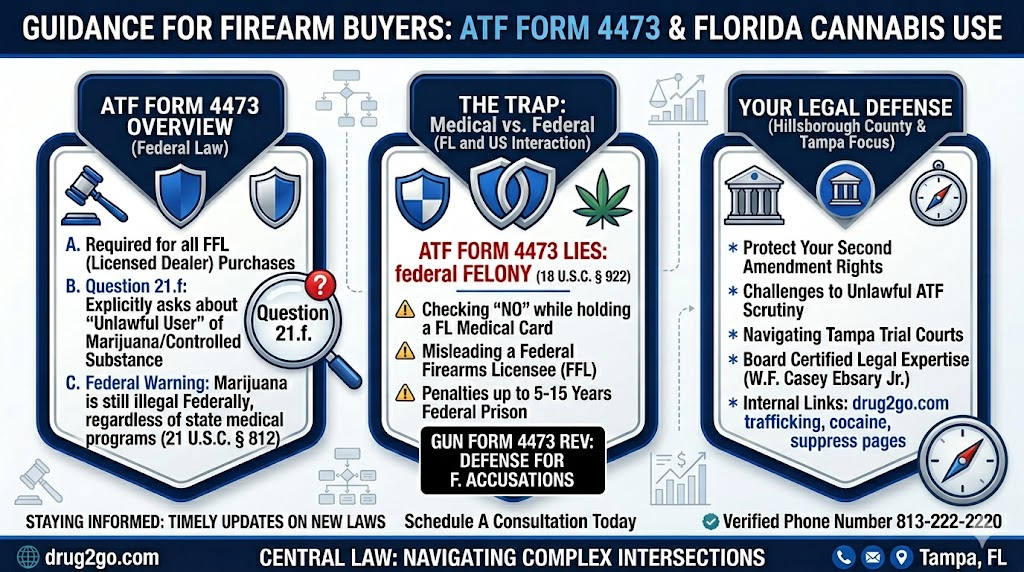
The current ATF Form 4473 specifically asks whether the purchaser is an unlawful user of marijuana or another controlled substance and warns that marijuana remains unlawful federally regardless of state legalization.
What does Question 21(f) on Form 4473 say?
The form asks:
“Are you an unlawful user of, or addicted to, marijuana…”
The form further warns that marijuana remains unlawful under federal law even if legalized for medical or recreational purposes by a state.
What happens if a firearm purchaser answers incorrectly?
Federal law treats false statements on firearm transaction forms very seriously.
A purchaser who falsely answers questions on ATF Form 4473 may face federal criminal exposure. The form specifically warns that false statements can constitute felony offenses under federal law.
Firearm and Cannabis Compliance Matrix
| Buyer Status | Current Form 4473 | Risk Level |
|---|---|---|
| Recreational Cannabis User | Prohibited | High |
| Medical Marijuana Patient | Significant Federal Concerns | High |
| Former User (No Current Use) | Case-Specific Analysis Required | Moderate |
| Non-User | Standard Review | Low |
Confronting Drug Charges in Tampa: The Strategic Advantage of Board-Certified Trial Expertise with Drugs and ATF Form 4473
A drug arrest in Tampa or anywhere in Hillsborough County can instantly place your future at risk. Whether the allegation involves marijuana, cocaine, fentanyl, oxycodone, methamphetamine, or a drug trafficking offense, prosecutors often move quickly to build a case that can result in jail, prison, probation, driver’s license consequences, and a permanent criminal record.
I am W.F. “Casey” Ebsary Jr., a Florida Bar Board Certified Criminal Trial Lawyer. Board Certification is the highest level of recognition awarded by The Florida Bar to attorneys who demonstrate substantial trial experience, professionalism, and specialized knowledge in criminal law. When your freedom is at stake, experience in the courtroom matters.
At Drug2Go, we examine every aspect of the government’s case, from the legality of the traffic stop to the validity of search warrants, confidential informants, K-9 deployments, forensic testing, and the increasingly complex overlap between Florida drug laws and federal firearms regulations.
Immediate Help After a Drug Arrest
If you or a loved one has been arrested for a drug offense in Tampa, contact our office immediately.
Learn more about attorney Casey Ebsary:
https://drug2go.com/about/
Request a confidential case review:
https://drug2go.com/contact/

What Happens After a Drug Arrest in Tampa?
How does a case involving Drugs and ATF Form 4473 begin in Hillsborough County?
Following an arrest, most defendants are transported to Orient Road Jail where they will appear before a judge within approximately 24 hours for a First Appearance Hearing. During this hearing, the court determines probable cause and addresses bond conditions.
The State Attorney’s Office then reviews police reports, body camera footage, laboratory evidence, and witness statements before deciding whether to formally file charges. This review period can significantly impact the direction of the case.
An experienced criminal defense attorney can often begin gathering evidence immediately, obtaining surveillance footage before it disappears, preserving witness statements, and identifying constitutional issues before the prosecution has finalized its strategy.
What are the most important decisions during the first 48 hours?
The first 48 hours frequently determine whether evidence can be preserved and whether constitutional violations can be challenged effectively. Many defendants unknowingly make statements to investigators that later become central pieces of evidence.
Early intervention allows a defense lawyer to begin analyzing search warrants, arrest affidavits, body camera footage, and laboratory procedures before critical evidence is lost.
How Does Florida Classify Drug Crimes?
Why do drug classifications matter in Drugs and ATF Form 4473 cases?
Florida’s drug laws are primarily governed by Florida Statute 893.13 and Florida Statute 893.135.
Florida Statute 893.13:
https://law.justia.com/codes/florida/title-xlvi/chapter-893/section-893-13/
Florida Statute 893.135:
https://law.justia.com/codes/florida/title-xlvi/chapter-893/section-893-135/
The classification of a controlled substance often determines whether a charge is a misdemeanor, felony, or trafficking offense carrying mandatory prison sentences.
Drug Classification and Penalty Overview
| Substance | Possession Threshold | Typical Charge | Maximum Penalty | Firearm Concerns |
|---|---|---|---|---|
| Cannabis | Under 20 grams | 1st Degree Misdemeanor | 1 Year Jail | Federal firearm restrictions |
| Cocaine | Under 28 grams | 3rd Degree Felony | 5 Years Prison | Enhanced federal scrutiny |
| Fentanyl | Under 4 grams | 3rd Degree Felony | 5 Years Prison | Significant federal exposure |
| Oxycodone | Varies | 3rd Degree Felony | 5 Years Prison | Potential firearm enhancements |
| Methamphetamine | Varies | 3rd Degree Felony | 5 Years Prison | Federal sentencing concerns |
How Do Prosecutors Prove Intent to Sell Drugs?
What evidence do prosecutors rely upon?
In most cases, prosecutors do not possess direct evidence proving a defendant intended to sell narcotics. Instead, they attempt to establish intent through circumstantial evidence.
Common indicators include digital scales, cash, multiple cell phones, packaging materials, text messages, and individually packaged substances. Prosecutors argue these items suggest commercial activity rather than personal use.
The defense often focuses on presenting alternative explanations for these items. Cash, scales, and packaging materials frequently have innocent explanations that undermine the prosecution’s theory of intent.
Why is intent so important?
The difference between simple possession and possession with intent to sell can mean the difference between probation and a lengthy prison sentence.
Because intent is often inferred rather than directly proven, it frequently becomes one of the most aggressively contested issues in a drug case.
What Constitutional Issues Can Lead to Dismissal?
Can an illegal search destroy the prosecution’s case?
Absolutely.
One of the strongest defenses in any drug case involves challenging the legality of the government’s search and seizure procedures under the Fourth Amendment.
Constitutional Evaluation Chart
| Investigation Stage | Defense Review |
|---|---|
| Traffic Stop | Was there reasonable suspicion? |
| Vehicle Search | Was consent valid? |
| K-9 Deployment | Was the detention unlawfully extended? |
| Search Warrant | Was probable cause established? |
| Home Search | Was the warrant properly executed? |
| Seizure of Evidence | Were constitutional rights respected? |
What police mistakes occur most frequently?
Unlawful traffic stop extensions remain one of the most common constitutional violations. Officers frequently detain motorists beyond the purpose of the original stop while waiting for drug-detection dogs.
Search warrants based upon stale information or unreliable confidential informants can also be challenged successfully.
Consent searches frequently become an issue when officers claim permission was granted while the circumstances suggest coercion or intimidation.
How Does a Motion to Suppress Work?
What is a Motion to Suppress?
A Motion to Suppress asks the court to exclude evidence obtained in violation of constitutional protections.
When drugs, firearms, statements, or electronic evidence are suppressed, prosecutors often lose the ability to prove their case.
Why are suppression hearings important?
Suppression hearings frequently determine the outcome of a case before trial ever begins.
If a judge excludes the drugs themselves, the prosecution may have no practical ability to continue the case. This can lead to dismissals, significant charge reductions, or favorable plea negotiations.
What Diversion Programs Are Available?
Can first-time offenders avoid a conviction?
In many cases, yes.
Hillsborough County offers diversion opportunities for eligible defendants through programs authorized under Florida law.
What is the Drug Pretrial Intervention Program?
Florida Statute 948.08 authorizes pretrial intervention programs for qualifying defendants including those with prescription drug charges.
Statute Link:
https://law.justia.com/codes/florida/title-xlvii/chapter-948/section-948-08/
Participants generally complete treatment, counseling, drug testing, and court supervision requirements.
Successful completion may result in dismissal of charges, creating opportunities for record sealing or expungement.
Diversion Program Flow
| Step | Requirement |
|---|---|
| Eligibility Review | Nonviolent offense |
| Program Admission | Prosecutor approval |
| Treatment Phase | Counseling and testing |
| Court Monitoring | Regular reviews |
| Graduation | Charges dismissed |
What Are the Most Effective Drug Defenses?
What is constructive possession?
Constructive possession cases arise when drugs are found in locations accessible to multiple people.
The prosecution must prove knowledge and control. Merely being near narcotics is insufficient to establish guilt beyond a reasonable doubt.
Can laboratory testing be challenged?
Yes.
The state must prove the seized substance is actually a controlled substance. Laboratory procedures, chain of custody issues, contamination concerns, and testing errors can all become important issues during litigation.
What role does medical amnesty play?
Florida’s Good Samaritan and overdose protection laws may provide significant defenses when individuals seek emergency medical assistance during overdose situations.
Proper analysis of these protections can sometimes result in dismissal of charges.
Frequently Asked Questions About Tampa Drug Charges, Drugs, and ATF Form 4473
Can a passenger be charged when drugs are found in a vehicle?
Yes. Prosecutors frequently rely upon constructive possession theories to charge passengers. However, they must prove more than mere presence in the vehicle. The state must establish knowledge and control beyond a reasonable doubt, which is often difficult when multiple occupants have access to the area where drugs are discovered.
Should I consent to a police search?
Generally, individuals have the right to refuse consent to a search unless officers possess a valid warrant or another legal exception applies. Consenting to a search often eliminates important constitutional challenges that might otherwise be available later in court.
Can drug charges be expunged?
Potentially. Eligibility depends on the outcome of the case and prior criminal history. Dismissals, dropped charges, and acquittals frequently create opportunities for sealing or expungement under Florida law.
Will a medical marijuana card protect me from federal gun laws?
No. Federal firearm regulations and federal controlled substance laws operate independently from Florida’s medical marijuana program. This remains one of the most legally complex areas of criminal law today.
Should I hire a lawyer immediately after arrest?
Yes. Early legal intervention often provides the greatest opportunity to challenge searches, preserve evidence, negotiate with prosecutors, and identify diversion opportunities before the case gains momentum.
H2: Speak With a Tampa Drug Defense Lawyer Today
Drug charges can threaten your freedom, professional licenses, firearm rights, immigration status, and future employment opportunities. The sooner an experienced trial lawyer becomes involved, the greater the opportunity to challenge evidence and protect your constitutional rights.
Contact W.F. Casey Ebsary Jr.
Attorney Bio:
https://drug2go.com/about/
Confidential Contact Form:
https://drug2go.com/contact/
Phone: 813-222-2220
When the stakes involve drug trafficking allegations, possession charges, search warrant litigation, ATF Form 4473 issues, or the intersection of cannabis and firearm laws, experience matters. Contact Drug2Go today for a strategic evaluation of your case.
We Accept the Following Credit Cards:


